
The marketing stack has never contained more data. Strategy has never moved more slowly. The gap between analysis and action is not a technology problem — it is a workflow problem. AI chat is closing it.
Why Most Marketing Knowledge Never Turns Into Execution
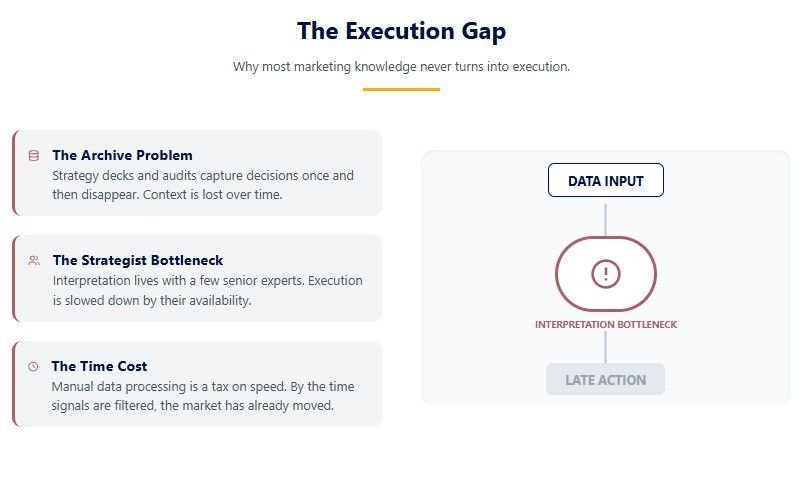
Every quarter, marketing organizations produce more analysis than any team can act on. Strategy decks are written. Performance reviews are delivered. Audits stack up in shared folders. The work is done, and then it disappears — not deleted, but effectively inaccessible at the moment a decision actually needs to be made. This is not a failure of effort. It is a structural failure of how knowledge moves through organizations.
The Archive Problem
Strategy decks, audits, and performance reviews capture decisions once and then disappear from the workflow. The document exists. The reasoning behind the decision does not travel with it. When a new campaign launches three months later, the team that built the original strategy may have turned over, the context has been lost, and the analysis gets redone from scratch. Organizations are not accumulating learning — they are running parallel loops of the same work.
Reporting Without a Decision Layer
Teams measure everything. Open rates, ROAS, impression share, pipeline velocity — the dashboards are comprehensive. But the output of a well-built report rarely becomes a prioritized action sequence. Reporting describes what happened. It does not tell a media buyer where to shift budget on Tuesday morning, or tell a content team which topic cluster is underserving commercial intent. The measurement infrastructure is mature. The interpretation infrastructure is not.
The Strategist Bottleneck
Interpretation lives with a few people. Execution lives with everyone else. In most agencies and growth organizations, two or three senior strategists carry the analytical thinking that shapes how channels are run. When those people are unavailable, in review cycles, or simply overwhelmed, decisions slow down or default to convention. Learning slows down with it. Junior operators execute without understanding the reasoning, which means they cannot adapt when conditions change.
The Time Cost of Manual Analysis
Data processing is a tax on speed. By the time a performance analyst pulls channel data, reconciles attribution, filters for meaningful signals, and presents findings to a strategist who can act on them, the market has already moved. Paid search auctions shifted. A competitor ran a flash sale. The organic ranking that was worth capturing last week has already been claimed. Analytical lag is not a minor inconvenience. In performance channels, it is a measurable revenue cost.
| KEY FRICTION POINTS→Repeated analysis across quarters with no cumulative learning→Insights that never enter sprint planning or budget cycles→Lag between performance signal and budget reallocation→Loss of historical context when team composition changes→Channel teams working in isolation from one another’s data |
AI Chat as the Interpretation Layer on Top of the Marketing Stack
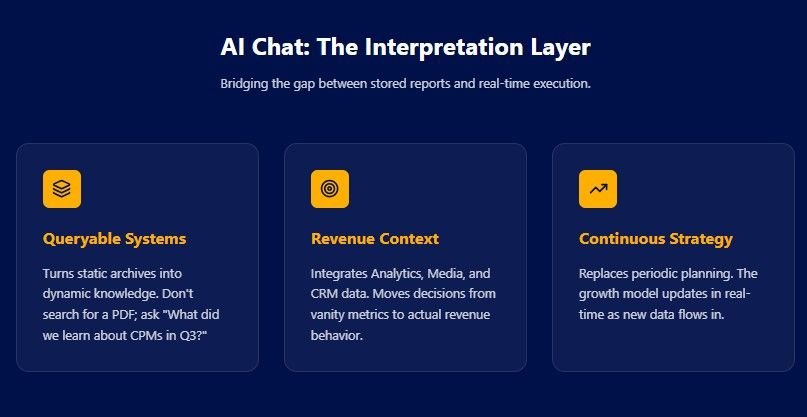
The question is not whether AI will change how marketing strategy is developed — it already is. The more precise question is which layer of the workflow AI occupies. The answer is becoming clear:AI chat functions best not as a content generator or a reporting replacement, but as an interpretation layer. It sits above the data and below the decision, converting accumulated analysis into actionable context at the moment it is needed.
From Stored Reports to Queryable Systems
Historical performance becomes usable in live planning when it can be queried rather than searched. A strategist looking at a new campaign brief does not need to open five quarterly reviews — they need to ask what the brand learned about upper-funnel CPMs in Q3 and have that answer in thirty seconds. AI chat turns static archives into dynamic systems. The knowledge was always there. The interface that makes it immediately accessible was not.
Connecting Analytics, Media Data, and CRM Context
The most consequential decisions in digital marketing are made at the intersection of channel data and revenue data. A campaign that drives strong click volume but converts at half the expected rate is not a targeting success. A content program that builds large audiences but fails to accelerate pipeline is not a growth asset. When AI chat integrates analytics exports, media performance data, and CRM context, decisions get made from revenue behavior rather than channel metrics. The signal improves. The strategy improves with it.
Continuous Strategy Instead of Periodic Planning
Quarterly planning cycles are an artifact of the time it took to process data, synthesize findings, and align stakeholders around new direction. When interpretation is continuous — when every new dataset updates the growth model in real time — the planning cycle becomes a formality rather than a functional necessity. Teams can adjust strategy weekly based on actual signals rather than waiting for the calendar to authorize a new direction.
Turning Audits and Teardowns Into Execution Roadmaps
An SEO audit that identifies two hundred technical issues has limited value if it sits in a PDF. The same audit, parsed and prioritized through AI chat, becomes a sprint backlog. Issues are ranked by estimated impact, assigned to the appropriate team, and sequenced by dependency. Long-form analysis — the kind that senior consultants used to spend weeks producing — converts into test cycles and technical roadmaps that execution teams can act on immediately. The gap between diagnosis and treatment collapses.
| OPERATIONAL OUTCOMES→Shorter planning cycles without loss of analytical depth→Faster budget reallocation in response to live performance signals→Shared strategic context that spans channel teams and disciplines→Reduced dependency on static documentation and tribal knowledge |
A New Learning Loop for Digital Marketers
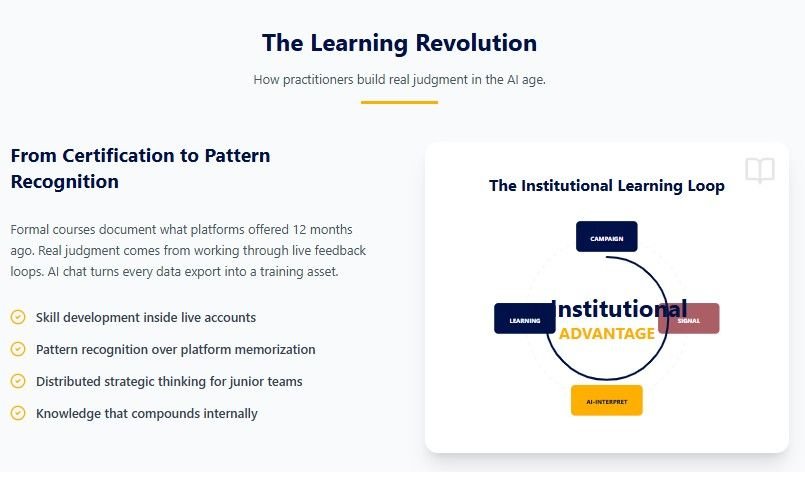
The way digital marketers develop capability has not changed proportionally with the tools available to them. Courses teach platform mechanics. Certifications validate familiarity with dashboards. But the actual skill that determines performance — the ability to read a complex system and make a better-than-average decision faster than a competitor — is still learned almost entirely through accumulated practice. AI chat is restructuring that learning loop.
Skill Development Inside Live Accounts
Capability grows fastest through interaction with real performance material. A media buyer who spends six months managing a single mid-size account learns more from that exposure than from any structured curriculum — because the account is a live system with real feedback loops, real budget consequences, and real pattern repetition across campaigns. AI chat extends that principle: it creates a structured dialogue with actual performance data, turning routine analysis into active learning. Every query a marketer builds deepens their understanding of how the system behaves.
Pattern Recognition Over Platform Memorization
Platform interfaces change. Algorithm updates shift optimization logic. The specific mechanics of running a Performance Max campaign will look different in eighteen months than they do today. What does not change is the underlying structure of how paid attention systems work, how content quality signals surface in organic rankings, and how conversion rates respond to offer clarity. Marketers who learn through AI-assisted analysis develop pattern recognition rather than platform familiarity — a skill that transfers when the tools change, as they always do.
Distributed Strategic Thinking in Teams
One of the most underappreciated consequences of the strategist bottleneck is what it does to team development. When interpretation is centralized, junior and mid-level operators do not develop strategic judgment — they develop execution proficiency. They learn how to run campaigns but not how to evaluate them. AI chat changes this by giving every member of a team access to the same decision context. A junior analyst can now explore the same performance questions a director would ask, and develop the reasoning capacity that normally requires years of proximity to senior thinking.
Internal Knowledge That Compounds
The most durable competitive advantage in marketing is an institutional understanding of what works for a specific brand in a specific market. That understanding is built campaign by campaign, and it is almost always lost — in turnover, in documentation gaps, in the difference between what a strategist knows and what they wrote down. When AI chat retains and makes queryable the learning from each campaign, the knowledge compounds. Each new initiative starts from a higher baseline. The organization gets smarter over time instead of resetting with every personnel change.
What This Changes for Agencies and Growth Organizations
The impact of AI chat on marketing organizations is not evenly distributed. Teams that adapt their workflow will see structural advantages in output, speed, and capability development. Teams that continue to treat AI as a production shortcut — a faster way to write copy or generate briefs — will miss the more significant leverage. The change is at the level of how organizations are structured to make decisions.
From Campaign Execution to Decision Infrastructure
The value an agency provides to a client has always been described in terms of execution: campaigns launched, content produced, media managed. That framing is becoming obsolete. The scarce resource is not execution capacity — it is interpretation capacity. Clients do not struggle to find people who can publish content or manage ad spend. They struggle to find people who can look at six months of cross-channel data and tell them what to do next. Agencies that build decision infrastructure — systems that make accumulated analysis continuously actionable — move from being execution vendors to being growth partners. That is a different conversation, at a different price point.
Faster Onboarding and Capability Scaling
The traditional model for bringing a new team member up to speed is proximity. They shadow a senior strategist, sit in on client reviews, absorb context over months until they can operate independently. This model is slow, inconsistent, and scales poorly. When historical data and strategic context are queryable, new team members can develop working understanding of an account in days rather than months. They are not reading through file archives — they are interacting with the account’s performance history directly, building context through structured inquiry rather than passive observation.
Client Reporting That Leads Directly to Action
The monthly reporting call is one of the most expensive fixed costs in agency relationships — expensive in time, in preparation effort, and in the opportunity cost of stakeholder attention. It is also frequently inconclusive. Data is presented, questions are raised, and follow-up items are promised but rarely prioritized. When reporting is built through AI-assisted analysis, every review ends with a tested next step. The data has already been interpreted. The decision has already been framed. The conversation moves from describing performance to directing action, which is what clients are actually paying for.
A Different Definition of Senior Talent
Seniority in marketing has traditionally been defined by pattern recognition built over years of exposure to campaigns across industries and scales. That experience still matters. But the advantage increasingly comes from a different capability: asking better questions and allocating resources faster. The best strategists in the next five years will not be the ones who have seen the most campaigns — they will be the ones who can frame the right analytical question, interpret the output correctly, and translate it into resource allocation decisions before competitors can run their next planning cycle.
| STRATEGIC ADVANTAGES→Higher output per strategist across accounts and disciplines→Consistent analytical thinking applied uniformly across client portfolios→Faster experimentation cycles with shorter feedback loops→Measurable reuse of institutional knowledge across campaigns→Stronger client retention through performance clarity and decisive reporting |
The End of Passive Learning in Digital Marketing
Digital marketing education has always lagged behind digital marketing practice. Courses document what platforms offered twelve months ago. Certifications measure familiarity with interfaces that will change before the badge expires. The practitioners who develop real capability do so through active engagement with live systems — and that gap between structured education and live practice is now being closed.
Courses as Reference, Not Primary Training
Formal training programs are not going to disappear, but their role is narrowing to reference rather than primary development. A course that explains how conversion tracking works is useful context. It does not build the judgment to diagnose why a specific account’s conversion data is unreliable, which channels are misattributing revenue, and what the correct optimization signal should be given the attribution constraints. That judgment comes from working through real problems against real data — which is exactly what AI-assisted analysis enables.
The Working Environment Becomes the Curriculum
Every report, audit, and data export is a training asset when the right interface exists to extract learning from it. A media buyer who queries their own account performance to understand why CPL increased in a specific segment is not doing busywork — they are developing the pattern recognition that will allow them to anticipate the same dynamic across other accounts. The working environment contains more high-quality training material than any structured curriculum could produce. AI chat is the interface that makes that material pedagogically useful rather than merely present.
Speed of Understanding as the New Competitive Edge
Certification volume is not scarce. Practitioners who have completed platform certifications are not a limited supply. What is genuinely scarce — and genuinely decisive in competitive markets — is the speed at which a team can take an ambiguous performance signal and convert it into a correct decision. The fastest interpreters win. Not because they have more credentials or more years of experience, but because they have built the infrastructure to move from data to decision faster than organizations that are still running analysis through manual cycles and committee review.
Conclusion
Digital marketing is becoming a real-time system of input, interpretation, and action. The platforms generate more signal than any team can manually process. The organizations that grow fastest will not be the ones with the largest headcount or the most sophisticated tech stack — they will be the ones with the shortest distance between a performance signal and a resource allocation decision.
AI chat is the interface that makes accumulated knowledge usable at the moment a decision is required. Not as a replacement for strategic thinking, but as the infrastructure that makes strategic thinking available continuously, across the entire team, at the speed the market demands.
The advantage moves to teams that can convert stored analysis into immediate execution. Every other capability follows from that one.