
Many AI music discussions focus on the first moment of output. A user enters a prompt, a song appears, and everyone asks whether it sounds impressive. That moment matters, but it is not where long-term usefulness is decided. In creative work, the first result is rarely the whole story. What matters just as much is whether the system helps the user keep track of what happened, return to stronger versions, compare alternatives, and refine the next attempt with more intention.
That is one of the most practical ways to understand ToMusic. Yes, it can generate music from prompts or lyrics. But just as importantly, it stores those results in a music library with related metadata. That seemingly simple archive layer changes the product from a spectacle into a workflow. An AI Music Generator becomes far more useful when it remembers how ideas evolved rather than simply producing isolated outputs.
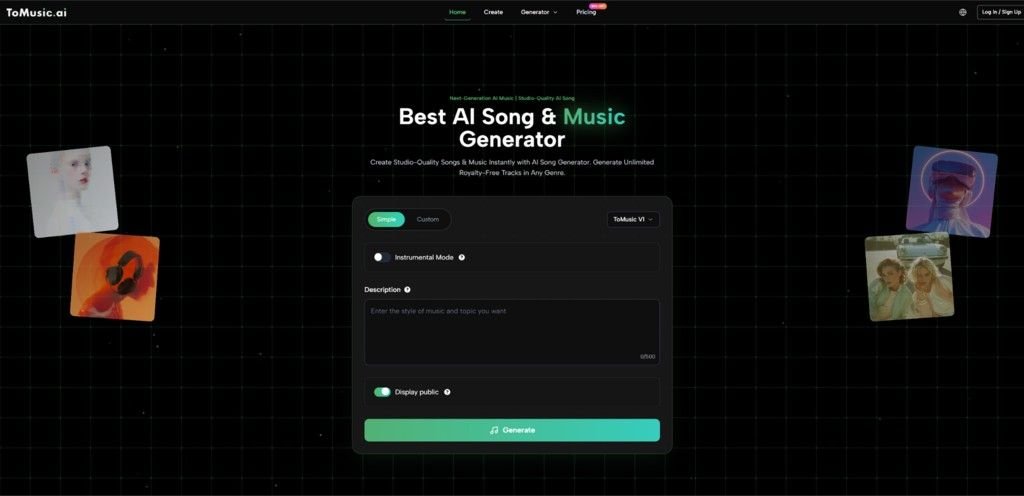
This matters because music generation is rarely linear. A user may create five versions before discovering that version two had the strongest mood, version four had the best arrangement shape, and version five had the best vocal tone. Without saved context, those insights disappear. With saved context, creative trial becomes a reviewable process instead of a blur.
Why Music Creation Needs More Than Output
A song draft is not just a file. It is a decision embedded in a process. It reflects a specific model choice, a certain prompt or lyric set, a mood assumption, and a set of tonal expectations. If only the audio remains and everything else is lost, the user is left with results but not with learning.
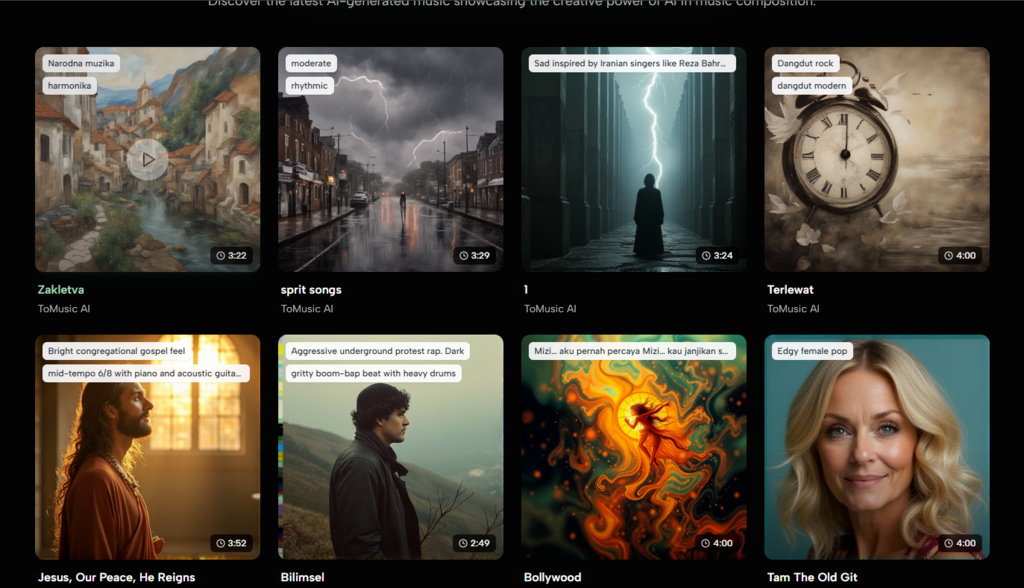
ToMusic’s library approach helps solve that. Generated tracks can be stored together with titles, descriptions, lyrics, and parameters. In practical terms, this means the platform is not only generating. It is preserving the logic of creation.
Why Preservation Leads To Better Iteration
A creator can only improve intentionally if they know what they are improving from. Saved parameters make that easier.
Why This Supports Serious Use
Casual experimentation may not need an archive. Repeated creative work does. Anyone producing multiple drafts over time benefits from retained context.
How ToMusic Creates A Repeatable Workflow
The product’s visible flow is simple: choose a model, enter a prompt or lyrics, generate a song, and save the result. But that simplicity hides a more important pattern. Once results are stored, the workflow becomes circular. Users can review, compare, revise, and generate again with greater clarity. That loop is where real productivity begins.
Rather than treating each generation as a one-time event, the platform encourages accumulated judgment. Over time, users begin to notice which prompts create stronger choruses, which models suit their style, and which emotional framings repeatedly produce better outcomes.
Why The Four Models Matter Inside The Archive
The value of saved drafts becomes even greater because ToMusic offers multiple models. Each model can interpret the same idea differently, and the library becomes the place where those interpretations can be meaningfully compared.
| Workflow Element | What The Platform Preserves | Why It Helps |
| Prompt or lyrics | Original creative input | Keeps the starting point visible |
| Model choice | V1, V2, V3, or V4 | Makes comparison sharper |
| Generated track | Audible output | Enables evaluation |
| Metadata history | Titles, descriptions, parameters | Supports repeatability |
This is significant because creative progress often comes from noticing patterns, not from chasing isolated success. A good archive turns instinct into something closer to a method.
A Three-Step Process That Supports Continuity
The official workflow remains compact, which helps the platform stay approachable.
Step 1. Select A Model And Choose The Input Route
Users decide whether to work from a prompt or from lyrics, then choose which model best fits the session.
Step 2. Provide Clear Musical Direction
The user describes the song through genre, mood, tempo, instrumentation, and vocal characteristics, or by supplying lyrics with relevant framing.
Step 3. Generate And Save The Draft
Once the song is created, it can be stored in the music library for review, comparison, and later iteration.
Why Saved Context Changes Creative Behavior
When outputs are stored well, users become more willing to experiment. They know they are not throwing ideas into the void. A draft that fails in one way may still contain a useful mood, a strong hook shape, or a vocal texture worth revisiting. That security encourages more varied testing.
Why Better Comparison Leads To Better Taste
Taste develops through contrast. A creator learns faster when they can place two or three related outputs side by side and ask which one actually carries the intended emotion or structure.
Why This Makes The Product Feel Less Disposable
Many AI tools feel entertaining but forgettable because they do not support continuity. A saved-draft workflow gives ToMusic a more durable identity.
How This Benefits Prompt-Led Creation
For users who generate from descriptive prompts, the archive becomes a map of how language choices affect sonic outcomes. One version may prove that mentioning instrumentation sharpened the track. Another may show that the mood description was too vague. Over time, the user starts writing better prompts because the history of weaker and stronger prompts remains visible.
Why Prompt Improvement Becomes Easier
It is easier to learn from a bad brief when the resulting output is still accessible alongside the original wording.
Why Reusability Matters For Teams
Content creators or small teams working on repeated music tasks can use stored drafts as internal references for future projects. That makes the tool more operationally useful.
How This Benefits Lyrics-First Creation
The archive may be even more valuable for lyric writers. A writer can test the same text in different emotional frames, different models, or different vocal assumptions, then compare which treatment actually serves the lyric best. In this context, Lyrics to Music AI is not just about turning words into audio. It is about building a reviewable set of interpretations around those words.
A writer might discover that one version exposes overcrowded verses, while another reveals that the chorus finally has enough lift. Without stored versions, that feedback is fragmented. With stored versions, it becomes actionable.
Why Writers Need Traceable Attempts
Lyrics rarely improve in one pass. Rewriting depends on remembering what the earlier attempts taught.
Why This Supports More Confident Revision
When writers know that a stronger prior version remains safe, they become more willing to cut, rewrite, or radically reshape weaker lines.
What Additional Tools Suggest About The Product’s Direction
ToMusic also points toward downloadable formats like WAV and MP3, as well as tools such as stem extraction and vocal removal. These additions suggest that the platform sees generated music as something users may want to continue working with, not just listening to once. That aligns well with the archive-centered design.
The product seems built around the assumption that generation is one stage in a longer creative chain. That is a healthier assumption than framing the output as automatically final.
Where The Limits Still Need To Be Acknowledged
An archive does not solve every problem. Weak prompts remain weak prompts. Some drafts will still miss the intended tone. A saved song is not automatically a good song. Storage improves workflow, not taste.
But workflow matters. In AI-assisted creation, one of the easiest ways to waste time is to lose track of which attempt taught what. ToMusic reduces that waste by preserving context.
Why Repetition Is Often The Right Strategy
Generating again is not necessarily inefficiency. It is often how creators narrow in on the most suitable interpretation. The archive makes that repetition intelligent.
Why Human Selection Remains Essential
The platform can preserve options, but it cannot decide which option best serves the project, the audience, or the artistic intent. That choice still belongs to the user.
Why This Makes The Product More Honest
A system becomes more credible when it supports better decisions instead of pretending to eliminate decisions entirely.
Why ToMusic Works Best As A Memory-Aware Creative Tool
The strongest AI music tools are not only defined by how quickly they generate. They are also defined by how well they support thinking across multiple attempts. ToMusic makes sense through that lens. It helps users move from idea to draft, but it also helps them remember the path they took.
That is more important than it may sound. Creative progress is often less about making one brilliant thing and more about recognizing why one version works better than another. A platform that preserves those comparisons gives users something lasting: not just songs, but better judgment. And better judgment is what turns repeated experimentation into real creative momentum.