
In terms of technology, the year 2026 will undoubtedly mark a major turning point for many companies. We are gradually moving beyond artificial intelligence that we merely “chat” with (like the early ChatGPT models) and entering an era of AI that “acts” on its own, completely autonomously.
In technical jargon, this is referred to as agent-based AI or AI Agents. While most organizations today use artificial intelligence to generate text, very few have yet taken the leap toward autonomous action. Yet this is precisely where the real driver of growth lies.
Chapter 1 : From machine to autonomous assistant : Understanding the revolution behind AI Agents
To better grasp the scope of this digital revolution, let’s take a look back at how far we’ve come over the decades. Agent-based AI didn’t emerge overnight. It is the culmination of a fascinating evolution that is drastically raising the bar for the very concept of business productivity.
A Brief History Lesson
Let’s consider a simple analogy from everyday life: a restaurant kitchen.
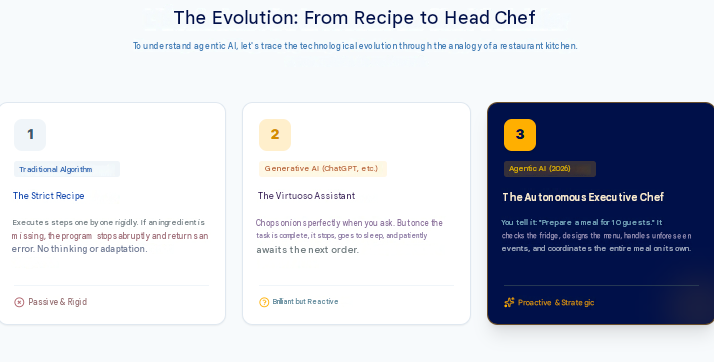
At first, the traditional algorithm worked exactly like a strict cooking recipe. Your programs simply execute the steps one by one, in a very rigid manner. They don’t really think for themselves. If an ingredient is missing, the machine stops dead in its tracks and displays an error message.
Then, generative AI emerged. It behaves more like an extremely talented and fast kitchen assistant. If you ask it to chop onions, it does so perfectly.
However, once its specific task is complete, this artificial intelligence stops. It goes into standby mode and patiently waits for your next command. It’s brilliant, undeniably creative, but remains fundamentally passive.
What exactly is an AI agent ?
If we go back to the analogy from earlier, the AI agent is like your company’s executive chef, which is a game-changer. You no longer have to give it fragmented instructions broken down into chronological subtasks.
You give them an overarching mission, a real business objective. For example: “Prepare a full meal for 10 guests by tonight.”
Faced with this request, the agent will open the refrigerator to check the available ingredients. It will then search for suitable recipes and decide on its own the order of preparation. If something unexpected comes up, our AI agent will adjust its plan in real time to complete the task. In other words, an AI agent is a program capable of planning and acting independently to carry out a task from start to finish.
You no longer need to hold its hand or guide it with every click. It understands the intent behind your request and takes the necessary steps to achieve it.
The Big Showdown : Traditional Chatbot vs. Assistant vs. Autonomous Agent
Many people confuse these three technologies, and I have to admit that they can easily be confused. Their promises may seem similar on paper, but they don’t offer the same value or return on investment at all.
Let’s clarify things with a concrete business scenario. Let’s say you have a dissatisfied customer who just sent you a message requesting to cancel their order and get a refund. How would each of our contenders respond?
The Classic Chatbot
This is the standard welcome bot, which is often a source of friction. It operates based on strict rules in the form of a scripted decision tree. Faced with our customer’s nuanced email, it won’t understand the context. It will go in circles and invariably end up responding with something like: “Sorry, I didn’t understand. Press 1 to speak to an agent.”
Good to know: For those selling services or products, integrating transactional AI chatbots remains a much better choice. These chatbot models are more responsive than traditional chatbot models.
The AI Assistant (e.g., Copilot)
It has a perfect command of natural language. By analyzing the customer’s email, it immediately detects dissatisfaction. It will then, on its own, suggest a perfectly worded apology email template. This is an undeniable time-saver. Nevertheless, it remains a tool for
Chapter 2 : Inside the Brain of an AI Agent: How Does It Work ?
The architecture of an AI agent is not limited to a simple text-generation algorithm. It is more like a structured cognitive ecosystem, designed to mimic the human thought and decision-making process. Let’s take a closer look at this technology to discover how it processes information and interacts with the real world.
The Main “Brain” (The Language Model)
At the heart of the reactor, there is always a Large Language Model (LLM). This is the same technology that powers well-known AIs such as ChatGPT, Gemini, and Claude.
However, the dynamics change completely here. In an agent-based system, this model is no longer used simply to hold a conversation or write poems. It is pushed to its absolute limits to act as a true logic processor. This “brain” deduces the hidden intentions behind your request. It is capable of breaking down a colossal problem into a multitude of manageable subtasks.
The Senses of AI (Perception)
For an assistant to act appropriately, it must know what is happening around it. Its “senses” are, of course, digital.
The agent becomes aware of its working environment through a network of sensors and software integrations. What does this look like in practice ? The AI agent can scan new incoming emails, detect an update in your CRM, read a PDF file that was just uploaded to a server, or even monitor traffic spikes on your website in real time. Without this continuous collection of information, the AI would run on empty and remain disconnected from the realities of your business.
Thinking Before Acting (Reasoning)
This is precisely where agent-based AI outperforms older generations of algorithms. When faced with a major obstacle, the agent never charges ahead blindly. It refuses to give up at the first error message.
Before doing anything, the system formulates a hypothesis. It silently tests a solution, observes the resulting outcome, and analyzes it critically. If the explored path leads to a dead end, its reflexive introspection mechanism kicks in. The tool then changes its strategy, reformulates its approach, and works around the obstacle to reach its ultimate goal. In fact, it is this continuous cycle of reflection that distinguishes an agent from a more traditional approach.
The Hands of AI (Action and Tool Use)
Having a super-powerful analytical brain is useless if you can’t interact with the physical or digital world. Modern agents are therefore equipped with action connectors, a technical capability that engineers call “Tool Use.”
These digital hands take the form of APIs. They give the agent the power to click buttons on your behalf, send out email campaigns, perform complex Google searches, issue bank refunds, or adjust prices in an e-commerce catalog. AI steps out of its dialog box to take control of your software.
Never Forget (The Different Types of Memory)
Have you ever chatted with a basic chatbot that forgets your first name after just three messages? This major flaw is eliminated thanks to advanced memory architectures.
For a workflow to be truly seamless, the agent juggles multiple layers of memory. Its short-term memory stores the immediate context of the conversation, which prevents unnecessary repetition. Even more impressive, its long-term memory archives your entire customer history and the company’s databases. This allows the system to personalize every interaction with surgical precision, while learning from its own mistakes to ensure they are never repeated.
Chapter 3 : The Different Personalities and Teamwork of Agents
Not all AI agents are cut out to accomplish the same feats or weather the same storms. In fact, modern engineering refuses to lump them all together. Today, we prefer to categorize them based on one key criterion: their natural ability to navigate the unexpected and resolve complex situations.
Simple Agents (Those That React Mechanically)
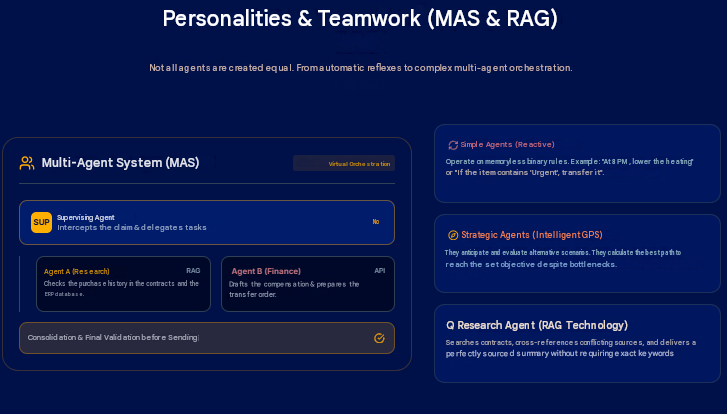
These rudimentary programs are notable for their complete lack of long-term memory. They learn nothing of substance from the past, and their world consists solely of purely conditioned reflexes. Their operating principle is binary. If a specific scenario arises, they mechanically trigger the associated action.
Take the example of office automation or home automation. Their instruction might be something like, “As soon as it’s 8:00 p.m., lower the heating temperature by two degrees.” Or, “When an incoming email has the word ‘Urgent’ in the subject line, automatically forward it to the on-call manager.”
In a closed, highly predictable environment where absolutely nothing deviates from the norm, their efficiency is formidable. But take them out of that very strict framework for just a moment, and they become completely disoriented.
Strategic Agents (Those Who Plan Toward a Goal)
Here, we’re taking it up a notch, or even several. These systems demonstrate significantly greater “intelligence” because they incorporate a genuine ability to anticipate. Here, the dynamics change considerably.
You simply set a final destination for them to reach. Whether it’s a business or administrative goal, they take it upon themselves to explore the various possibilities for achieving it.
Their reasoning ability closely resembles that of a modern GPS. To guide you to your destination, the tool calculates the best basic route, but it certainly doesn’t stop there.
It constantly evaluates alternative scenarios, anticipates bottlenecks, and weighs the pros and cons of every small detour. The strategic agent applies the same responsiveness to executing your projects. They deliberately choose the most optimized sequence of actions, even if new obstacles suddenly arise along the way.
Strength in Numbers : Teamwork (Multi-Agent Systems)
When tackling large-scale projects, entrusting the reins to a single artificial intelligence system quickly becomes problematic. The real must-have today is to use Multi-Agent Systems, or MAS.
Think of it as a sprawling virtual team where each entity has a highly specialized role. Imagine for a moment a “Supervisor” agent who intercepts a tricky customer complaint.
Rather than handling everything head-on and risking a mistake, the supervisor delegates the task of verifying the purchase history to Agent A. At the same time, the supervisor assigns Agent B to draft a financial compensation proposal. Once the tasks are completed, the supervisor consolidates and validates the entire case before triggering the sending of the final response.
The Search Agent (When AI Searches Your Documents for You)
How many hours does your team waste each month trying to find a specific document buried in a sea of files? RAG (Retrieval-Augmented Generation) technology, with its agent-based approach, was specifically designed to eliminate this friction. Forget traditional search bars that require you to type in the exact keyword or risk coming up empty-handed.
Today, you can assign a full-fledged investigative mission to your agent. Operating completely autonomously, it will comb through the intricacies of your contracts, sort through the mass of information, cross-reference sometimes contradictory sources, and ultimately deliver a crystal-clear, perfectly sourced summary to you on a silver platter.
Chapter 4 : Use Cases: How to Integrate AI Agents into Your Business
Using an AI agent is no longer a luxury reserved for tech giants. In just a few years, the market has become significantly more accessible. What once required months of complex coding is now within reach of any ambitious business.
“Turnkey” Solutions (For Those Who Don’t Know How to Code)
One of the major trends of 2026 is the rise of “no-code” agents. Today, there are highly user-friendly platforms that allow business teams to create their own assistants using simple drag-and-drop functionality.
There’s no longer any need to master complex programming languages. Major industry players, including HubSpot, Microsoft Copilot Studio, and orchestration tools like Make and n8n, greatly simplify the integration of AI agents into businesses.
The process is incredibly seamless. You connect your usual applications, write your instructions in everyday language, and the platform handles building the architecture in the background, it’s that simple.
This is undoubtedly the ideal entry point for small-to-medium-sized businesses looking to become more agile. In fact, if you’re seeking to make your administrative processes more reliable, integrating smart workflows to automate repetitive tasks is the logical first step before taking the leap toward a fully autonomous system.
Tools for Professionals (Custom IT Solutions)
However, it must be acknowledged that off-the-shelf solutions quickly reach their limits when faced with the demands of large-scale infrastructures. When operational stakes become critical or the absolute confidentiality of your algorithms requires it, expert developers must take the reins.
To design systems tailored to the exact specifications, AI engineers today prefer specialized open-source programming environments. Robust development frameworks such as LangChain, CrewAI, and AutoGen already largely dominate the market for custom AI agents.
Why go to all this trouble and make the complex choice to write code from scratch? Quite simply because these platforms allow for unmatched granular control. They enable your IT teams to erect strict firewalls around your databases and precisely fine-tune memory usage. Furthermore, you can model intricate business logic that no simplified visual interface could possibly offer your organization. This is the necessary step for deploying a sprawling network of secure agents within your enterprise.
How Do Agents Communicate With Each Other (Standardization) ?
Take a moment to imagine that your marketing department has set up a lead generation agent on HubSpot, while the logistics team uses a custom-built assistant for inventory management. For a customer order to be processed seamlessly from start to finish, these two distinct “brains” must exchange data.
This is where the crucial challenge of standardizing communications comes into play. To ensure that artificial intelligence systems from competing vendors can collaborate effectively, the software industry has had to establish a universal language. Open, standardized protocols, such as the Model Context Protocol (MCP) or the Agent Communication Protocol (ACP), now structure the network.
These cross-system “grammar rules” were designed so that your various virtual assistants can communicate with one another, exchange encrypted files, and synchronize their calendars seamlessly.
Chapter 5 : What Exactly Do AI Agents Do in a Company ?
Theory always looks appealing on paper. However, it is truly in the real world, when faced with the unexpected challenges of daily life, that agent-based AI really shines and proves its true return on investment (ROI). Far from being a mere technological gimmick, it is fundamentally reshaping the inner workings of organizations. Let’s take a look at how these systems directly impact recurring business functions.
Sales and Customer Service : the rise of the tireless assistant
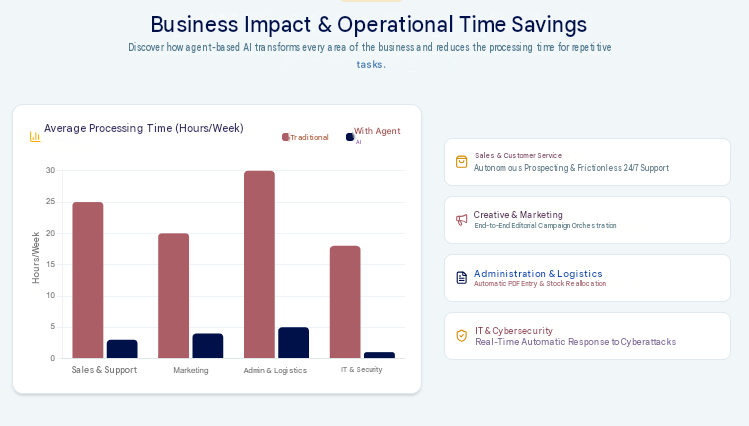
In the sales world, the system takes over the often thankless task of cold calling. Gone are the days of spending hours manually scouring the web. The system handles it entirely autonomously. It tracks down even the slightest business opportunities, cross-references decision-makers’ profiles with the latest news from their companies, and finally triggers email sequences with surgical precision.
Naturally, your CRM database is updated straight away, without anyone having to click ‘save’. The shift in customer support offers an equally radical promise. Whether it’s three o’clock in the morning or a Sunday public holiday, the AI takes over. Whether it’s resolving an access issue, resetting a locked account or setting up a complex refund process, the system operates without the slightest hiccup.
Creation and Marketing : orchestrating campaigns from A to Z
Forget those days, though they seem like only yesterday, when artificial intelligence was limited to simply generating bland drafts. The landscape has changed dramatically. Today, a marketing specialist acts as a true operational project manager. They first scrutinise emerging search trends, identify your competitors’ blind spots and independently devise a relevant editorial calendar. The hybrid writing stage (AI & human), format adjustments and publication across your various channels then follow seamlessly. All this is done whilst taking great care to scrupulously respect the tone and visual identity that define your brand.
Administration and Logistics : the elimination of tedious tasks
Historically, support functions have often been overwhelmed by the burden of paperwork and endless data-entry processes. This is now a thing of the past. A dedicated agent is now able to extract raw data from a pile of disparate PDF invoices and organise it accurately within your ERP system. Is an amount different from the initial quote? The system isolates the anomaly, sends a targeted alert to the accounts department, whilst silently preparing the bank transfer forms for the approved files.
On the logistics front, AI agents impress with their hyper-responsiveness. Imagine a sudden supply disruption at a regional hub. Without waiting for instructions, the AI will instantly reallocate available stock from another warehouse and recalculate the transport schedules for the entire fleet. It understands the situation and resolves the problem before it even turns into a delivery delay.
IT and Security : the invisible digital bulwark
Let’s not beat about the bush. At present, even the most sophisticated cyberattacks are orchestrated by offensive algorithms. Faced with threats capable of spreading in a matter of milliseconds, human reaction times are technically obsolete. To combat the machine, we must counter it with the machine. This is precisely the role of AI-powered cybersecurity agents.
As soon as abnormal network behaviour or an intrusion attempt is detected, the response is immediate. The system automatically isolates the compromised infrastructure. It then blocks all access deemed suspicious and deploys the initial remediation protocols. The incident is contained, the vulnerability patched, and the bulk of the crisis is managed well before the on-call team has had time to receive a notification on their phone.
Chapter 6 : The dangers and the rules of the game
Entrusting the reins of part of one’s business to a programme, however sophisticated it may be, is no trivial matter. Autonomy brings with it its own set of unprecedented risks. If you wish to deploy AI within your organisation, this is not something that can be improvised on the back of an envelope. It is a decision that demands absolutely uncompromising rigour when it comes to IT controls and security.
The importance of having good data
There is a fascinating paradox with AI agents. They are capable of dazzling intellectual feats, whilst at the same time displaying a disconcerting naivety. The machine blindly believes whatever it is fed. If your system relies on a database riddled with duplicates or obsolete pricing tables, the commercial consequences could be disastrous. The agent will have no qualms about offering a contract based on the terms and conditions from 2018. This is why the thorough cleaning and classification of your internal data forms the bedrock of any project. This is not an option; it is a non-negotiable prerequisite.
Staying in control : security and human validation
Artificial intelligence is far from infallible. It can still ‘hallucinate’, make up facts out of thin air or completely misinterpret the context of a request. It would therefore be sheer folly to entrust it with control of the cash flow or infrastructure without putting robust safeguards in place. In cybersecurity, we apply the golden rule of the ‘principle of least privilege’. The idea is simple: the agent must only have access that is strictly essential to carrying out its task. A tool designed to organise meetings has no reason whatsoever to be allowed to delete files from your server. Furthermore, whenever a decision involves significant financial, legal or strategic stakes, the inclusion of a supervisor at the end of the chain (the well-known ‘human-in-the-loop’ model) becomes an absolute imperative to validate the action before it is carried out.
Complying with the law and protecting our secrets (the GDPR)
The regulatory landscape is undergoing significant change. With the introduction of the European AI Act in 2026, the regulatory squeeze on companies using these technologies is tightening considerably. Make no mistake : from a legal perspective, you bear full responsibility for the actions taken by your agent. The issue of data sovereignty is becoming a burning one. It is more crucial than ever to track where your data is hosted, for example by prioritising servers located in Europe to avoid the reach of the US Cloud Act. Furthermore, the law now demands absolute transparency: a customer must always know whether they are interacting with a machine or a human. Aligning these new practices with strict compliance with the GDPR is not merely an administrative requirement; it is the only way to ensure your company’s legal survival.
The hidden cost : how much does it cost to make AI ‘think’ ?
We often overlook a technical detail that has significant financial implications. Every time an autonomous agent analyses a situation or queries an external tool, it consumes computing power. More specifically, it uses up ‘tokens’ for which you are charged on the fly by AI providers. What’s the catch? An agent that crashes and gets stuck in an infinite thinking loop, trying in vain to resolve an error. If no one cuts the power, the overnight cloud bill can literally skyrocket. Imposing strict budget limits at API level and monitoring query usage in real time are essential practices for optimising your resources.
Frequently Asked Questions about AI Agents
What is the difference between generative AI and an AI agent ?
Generative AI (such as ChatGPT) creates content based on a prompt. An AI agent goes a step further: it plans, makes decisions and uses tools (CRM, web) to carry out a complete task entirely independently.
Is my business ready to deploy an AI agent ?
Not necessarily. Before any integration, your internal data must be structured and centralised. That is why we always recommend a preliminary AI audit to assess your digital environment and identify the most cost-effective use cases.
Will autonomous agents replace my staff ?
No, the aim is to optimise your teams’ productivity, not to replace them. The AI agent automates time-consuming tasks, whilst humans supervise, validate strategic decisions and focus on empathy and high-value-added customer relations.
Is my data secure with these AI systems ?
Absolutely. Deploying professional AI agents involves secure API connections and private models. Your confidential information is never used to train external public models, thereby guaranteeing full control over your business data.
How long does it take to set up an agent ?
It depends on the complexity. A simple virtual assistant can be deployed in a matter of hours. A multi-agent system integrated with your CRM and ERP will require several days of development and will inevitably involve training your teams in digital tools and AI.
How much does it cost to set up an AI agent?
The cost depends on the complexity of the project and the API integrations required. Rather than an expense, think of it as an investment. A well-designed agent offers a rapid return on investment by drastically reducing your day-to-day operational costs.
Can AI agents improve my SEO ?
Yes, absolutely. AI agents analyse search intent in real time, optimise your internal linking structure and generate semantic content at scale. This is at the heart of our AISEO approach to boosting your visibility in the long term.
Do you need to know how to code to use an autonomous agent ?
No, not for day-to-day use. Once configured by our technical experts, you interact with the agent using natural language. Your teams simply need to learn the art of prompt engineering to effectively delegate complex tasks to it.
Do AI agents make mistakes or produce ‘hallucinations’ ?
As with any system, there is a risk of error. However, we use multi-agent architectures where a ‘verifier’ agent checks the work of the others. This significantly limits hallucinations, whilst retaining the absolutely essential final human validation.
Which departments within the company benefit the most ?
Marketing, customer service and human resources are the primary beneficiaries. The automation of advertising campaigns, the processing of customer tickets and the screening of CVs instantly frees up valuable time for all your operational teams.