
Summary
Creative agencies struggle to scale video production because manual editing hours create a hard operational ceiling. Modern AI video generators solve this bottleneck by turning text briefs into structured video drafts in minutes, letting creative teams deliver high-volume, multi-platform campaigns without expanding headcount.
Picture this scenario: your agency signs three new enterprise retainer clients in a single month. Your sales team celebrates the milestone and your monthly recurring revenue spikes. Yet over in the production bullpen, the atmosphere feels completely different. Each new client expects twenty to thirty short-form videos every month across multiple social channels. The editors who comfortably managed two accounts are suddenly drowning under five.
In a creative agency, delivery timelines represent the backbone of your client relationships. When due dates slip, first drafts arrive late, and the entire production workflow breaks down. What began as an exciting expansion turns into frantic triage. An agency that once eagerly pitched new business starts turning down qualified prospects.
Have you experienced this ceiling before? Most video and digital marketing agencies hit this wall eventually. The issue is rarely about talent, technical skill, or creative vision. The real issue is operational scale: how a bespoke creative craft turns into a repeatable production process as client accounts multiply.
Why Doesn’t Video Production Scale With Client Demand?
Video production does not scale naturally with client demand because output remains tied to a fixed physical constraint: editor hours. Client requests, ad briefs, and content calendars can multiply overnight. The hours in a working day do not.
A skilled video editor must review raw footage, log clips, sync dialogue, cut B-roll, mix audio, and design graphics. Each step demands intense manual focus. Regardless of an editor’s experience or speed, one human can only produce a finite number of finished minutes each week.
Hiring more editors seems like the logical solution on paper, but client demand rarely holds steady long enough to support permanent payroll. An agency that hires two full-time editors during a record quarter must still pay their salaries when client budgets dip next quarter. This dynamic triggers the classic agency margin squeeze: you feel the bottleneck in delivery times long before you can justify hiring additional staff.
How Turnaround Time Adds Up Against You
Modern marketing clients operate on rapid turnaround schedules. In paid social and performance marketing, creative assets suffer from ad fatigue within weeks. Brands require an ongoing pipeline of fresh visual hooks to maintain conversion rates. When clients compare delivery timelines across vendors, the operational gap between different production models becomes impossible to ignore.
| Video Format | Dedicated In-House Team | Solo Freelancer | AI-Assisted Agency Workflow |
|---|---|---|---|
| Short-form social clip (15-60 sec) | 12 to 24 hours | 2 to 3 days | 15 to 30 minutes |
| Product explainer or talking head (2-5 min) | 2 to 3 days | 4 to 6 days | 2 to 4 hours |
| Performance ad variant batch (5-10 iterations) | 4 to 6 days | 7 to 10 days | 1 to 2 hours |
| Multi-language localized video (3+ languages) | 5 to 7 days | 8 to 12 days | 2 to 3 hours |
Slower delivery numbers provide clients with an immediate reason to look elsewhere. In concrete terms, the deepest delays rarely stem from the editing timeline itself. The real lag occurs during feedback cycles. Waiting for client approvals and managing revision notes frequently adds five to seven days to a project that should take forty-eight hours.
What Do Agencies Usually Try First?
When production backlogs threaten client retention, most agencies reach for one of three familiar fixes before reconsidering their core assembly process.
Hiring Freelancers Per Project
Bringing in freelance editors represents the most common tactic to absorb excess demand without increasing fixed overhead. At the entry level, freelance editors charge between $50 and $100 per video for simple social cuts. Mid-level editors with several years of commercial experience command $150 to $300, while specialized motion designers easily bill $500 or more per asset.
If your agency produces only four or five supplementary videos each month, freelancing remains a cost-effective choice. Beyond that threshold, onboarding friction destroys the expected time savings. Each freelance contractor requires briefing on brand voice, typography guidelines, footage libraries, and revision expectations. Simply put, your senior producers spend more time managing contractors than delivering high-level client strategy.
Templated Editing
Pre-built timeline templates in editing suites like Adobe Premiere Pro or After Effects can accelerate straightforward, highly repetitive projects. Templates function well for standard podcast clips or basic animated quotes. The trouble begins the moment a client requests custom storytelling.
Imagine an athletic apparel client asking to modify a sequence by adding an unexpected testimonial hook, custom pacing, and variable aspect ratios. A rigid timeline template cannot accommodate those structural adjustments. Your editor must strip out the template layers and rebuild the composition by hand. What began as a time-saving shortcut quickly turns into a frustrating manual workaround.
Outsourcing Overseas
Offshore production hubs and remote overseas editing services offer lower hourly labor rates. However, this model introduces friction across other operational areas. Communication gaps and substantial time zone differences drag out feedback cycles. A quick title adjustment that should take fifteen minutes often takes a full twenty-four hours to cycle back.
Moreover, revision rounds beyond the initial review typically incur additional charges of twenty-five to fifty percent of the original project price. Agency managers still invest two to four hours per video on detailed briefs, asset transfers, and quality control. Once you calculate that internal management time, the apparent labor savings vanish entirely.
How Do AI Video Generators Change the Equation?
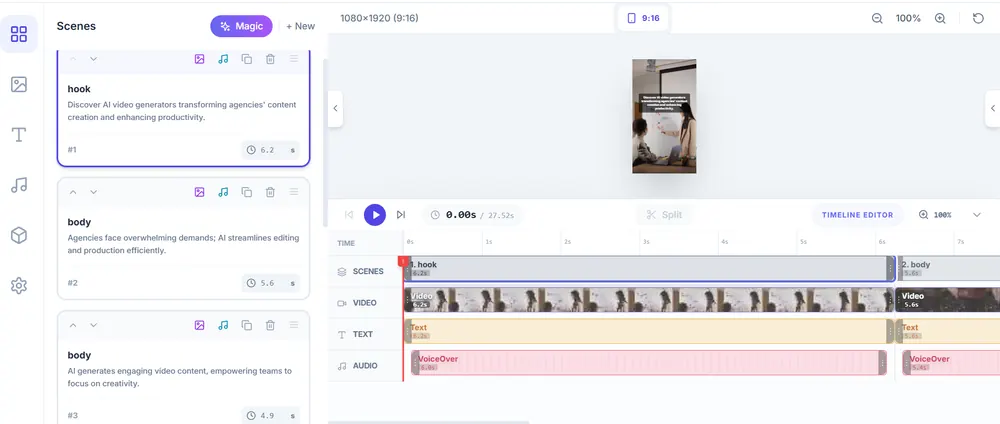
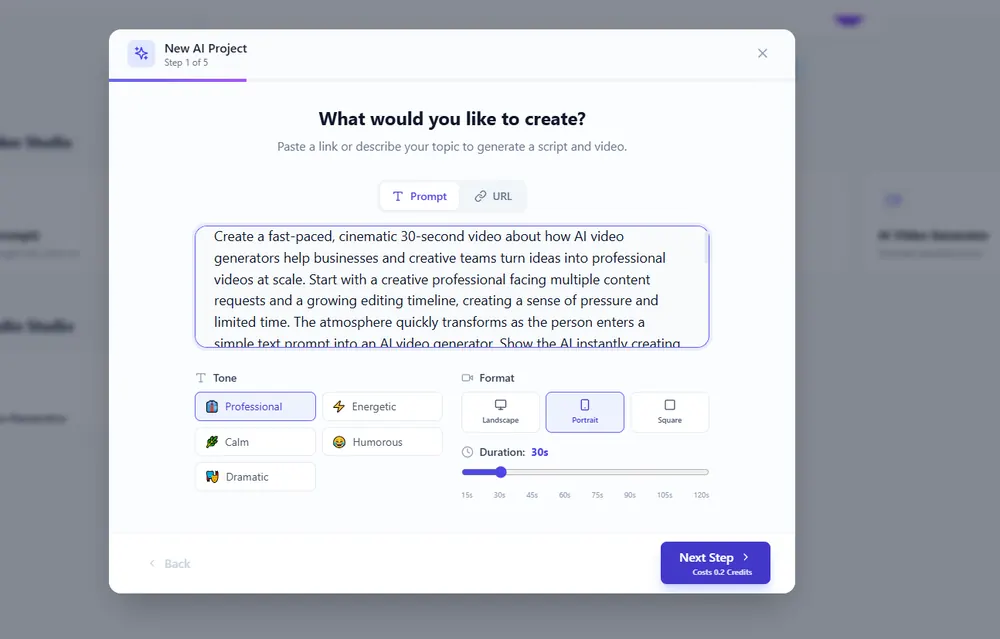
A video generator that turns a script into a complete video has changed the equation by automating the slowest parts of production which mainly includes scene planning, media selection, and voiceover recording. Instead of an editor manually assembling sequences from a blank timeline, intelligent tools analyze text prompts, scripts, or existing URLs to generate an editable storyboard in minutes.
In clear terms, this structural change removes the blank-canvas roadblock. Your production team no longer builds video timelines from zero. Instead, they begin every assignment with a fully structured draft ready for strategic review.
Automating the First Draft
Consider the labor involved in creating a conventional first draft. An editor reads the creative brief, logs voice recordings, combs through stock libraries, cuts out dead air, lines up B-roll, and inserts background audio. This administrative assembly consumes several hours before anyone evaluates the creative message.
Modern AI video platforms automate this heavy lifting entirely. The software parses your script into natural narrative scenes, matches each beat with relevant visual clips, generates human-sounding synthetic voiceovers, and generates synchronized captions. Your editor shifts from an asset assembler into a creative director, refining a draft that already exists.
Editing One Scene Instead of the Whole Video
Traditional timeline revisions are notoriously rigid. If a client requests a minor modification in the first ten seconds of an edit, your editor might need to ripple-edit the entire timeline, readjusting music drops, voice pauses, and visual transitions across the entire video.
Scene-level AI editing eliminates this operational drag. By breaking video content into independent visual scenes, the software allows you to alter a single scene in isolation. If your client requests a different headline hook or updated product footage, you modify scene two without altering the rest of the timeline. Your team completes revisions in minutes rather than hours.
Handling Multiple Markets and Platforms From One Project
Agency video campaigns cannot survive on a single platform format. Delivering a comprehensive digital campaign requires vertical 9:16 videos for TikTok, Instagram Reels, and YouTube Shorts, alongside 16:9 widescreen formats for websites and 1:1 square assets for social feed carousels.
AI video systems streamline this multi-channel output through two essential agency capabilities:
- Multilingual Voiceover Synthesis: You can translate a client’s core video into Spanish, French, German, or Portuguese with authentic synthetic voices. You eliminate the substantial delay and expense of booking separate foreign voice talent.
- Dynamic Multi-Platform Aspect Ratios: The engine automatically re-centers primary subjects across vertical, square, and horizontal aspect ratios, removing the need to rebuild separate project files for each channel.
Scaling Creative Iterations and Performance Ad Testing
In modern performance advertising, creative volume determines campaign profitability. Algorithms on platforms like Meta, TikTok, and YouTube prioritize accounts that test dozens of creative variations to find top-performing hooks.
Imagine an agency managing paid acquisition for an e-commerce footwear brand. Producing twenty distinct video variations manually requires days of tedious asset duplication and caption alignment. With an AI video engine, you simply swap three introductory visual hooks and two closing calls to action against the core product scene. Your agency outputs fifteen high-performing ad variations in less than an hour.
What This Does Not Replace
Adopting an AI video workflow does not mean replacing human creativity or brand strategy. High-impact video marketing still depends on human taste, emotional nuance, and deep commercial understanding.
An automated engine cannot determine your client’s unique brand positioning. It cannot uncover the core customer insight that drives an emotional buying decision. Online video generators like Movcut.ai, Higgsfield, or Fliki remove the manual labor of assembling raw media. Your agency provides the strategic direction, the creative concept, and the meticulous polish that clients pay for.
The Bottom Line
Video production stops scaling the moment billable editor hours become your agency’s growth ceiling. Freelancers, rigid templates, and offshore teams provide temporary patches, but none of them solve the root bottleneck of constructing every video by hand.
An AI video generator changes agency economics permanently. It cuts the turnaround window between client brief and reviewable draft from days to minutes. By building an agile, scene-based production line, your agency can comfortably accept new business, satisfy demanding timelines, and maintain healthy profit margins.
Frequently Asked Questions
What is an AI video generator and how does it work for agencies?
An AI video generator is software that converts written text, scripts, or media prompts into complete, structured video drafts. The platform uses machine learning to divide scripts into scenes, generate natural voiceovers, source relevant B-roll footage, and synchronize subtitles automatically within a flexible, browser-based production workspace.
Will AI video generators replace human video editors in creative teams?
No, AI video tools replace repetitive mechanical tasks rather than creative talent. Human editors transition into creative directors who guide narrative pacing, polish styling, and ensure strict brand compliance. Agencies using AI produce ten times more client assets without adding headcount or burning out their staff.
Can agencies legally use AI-generated videos in commercial client campaigns?
Yes, commercial AI video platforms grant full commercial usage rights for generated video files, synthetic voices, and licensed stock assets. Always verify that your agency software subscription includes commercial licensing so client deliverables remain fully compliant with advertising regulations and copyright standards across all digital marketing channels.
How do AI video generators help agencies scale multi-platform ad testing?
Modern AI platforms allow agencies to convert one primary script into multiple aspect ratios simultaneously. You can export 9:16 vertical cuts for TikTok, 16:9 widescreen formats for YouTube, and 1:1 square versions for LinkedIn, while quickly generating multiple hook variations to maximize paid ad performance.
How much production time do AI video generators save per project?
Agencies typically reduce initial draft assembly time by seventy to eighty percent. Instead of spending six to eight hours sourcing clips and aligning basic cuts, editors produce a reviewable client draft in fifteen to thirty minutes, dramatically shortening revision cycles and speeding up project deliveries.