
The choice of where to purchase something online is made quicker than most people think. From the moment we recognize a need, we are almost instantly mentally sorting different retailers based on the patterns that we have learnt from our past purchases. This mechanism feels like a reflex but actually it is a complex comparison of price, trust, convenience, and past experience that is going on.
Awareness of how these decisions are really made explains why retailers that practice a good customer experience keep seeing their customers whilst those who focus only on pricing have a hard time attracting new ones.
People usually have a set list of places where they shop and it depends on the product category. For instance, the thought of buying electronics will most likely bring you to Amazon, buying furniture may make you think of specialty stores and if you are buying groceries, then you would probably think of an entirely different platform. These habits are not something that came about by chance, they are a result of your experience in proving which retailers have consistently been delivering in which categories.
Price as Starting Point, Not Deciding Factor
Of course, price is a key factor. Still, it seldom alone dictates the final decision. Shoppers are willing to pay a bit more to purchase from stores they trust, that provide better return policies, or that can deliver faster. The size of the premium depends on the product category and the urgency of the purchase, but it is there always in consumer behavior.
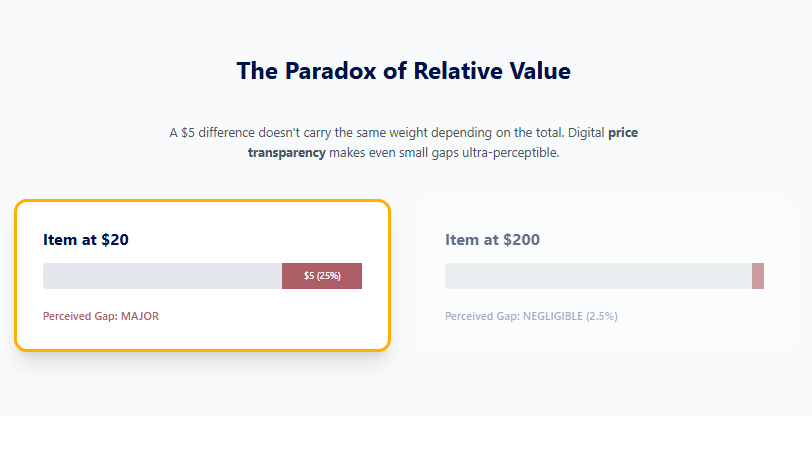
The place where the price difference decides the choice is to a great extent dependent on the whole purchase amount. A $5 difference on a $20 item seems quite a lot. The same $5 difference on a $200 purchase is hardly noticeable. People by habit calculate value through these relative comparisons rather than using absolute amounts.
Moreover, price transparency has affected the very meaning of price. When comparison shopping meant going to different stores, a few cents or dollars difference might have gone unnoticed.
But when seeing the prices of six different stores at once for the same products, even small price differences are very perceptible. Such transparency thus imposes the necessity on retailers either to offer other value factors than price or to accept lower margins.
Trust and Security Override Small Savings
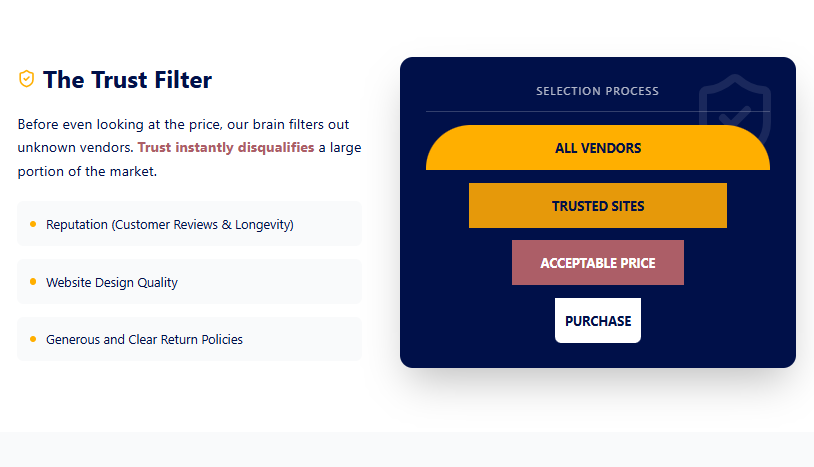
When you shop online, you have to put your payment details in the hands of a retailer and also trust that they will actually deliver what they promise. This level of trust instantly disqualifies a large number of vendors even before price consideration. A brand new retailer, even if they offer the lowest price, will lose out to a known one who charges five percent more.
Besides, trust is a huge factor in the buying decision and reputation indicators are the main elements that really help to build or destroy that trust. They include customer reviews, how long the company has been operating, widely recognized brands, and even the quality of the website design.
Return policies work not only as practical tools but also as indicators of trust. If a retailer is very generous with their returns, it means they are pretty sure about their products quality and customer service.
Convenience Factors That Compound Over Time
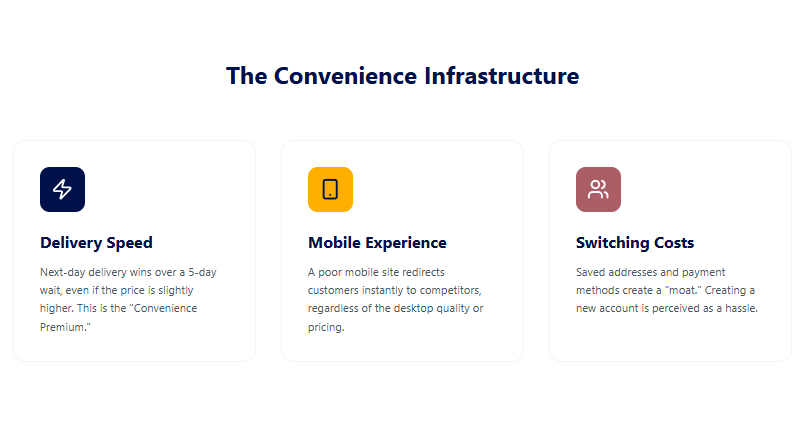
Delivery speed has, for many product categories, become a critical deciding factor. If two stores offer the same product at almost the same price, the one that offers next, day delivery will attract customers over the one showing a delivery time of five to seven days. This convenience premium represents the real worth people attach to receiving products quickly as opposed to waiting.
Account infrastructure leads to high switching costs which result in the retailer being favored where you already have accounts. By having saved addresses, payment methods, and order history, repurchasing becomes very easy. Making a new account somewhere else is perceived as a hassle, even though it only takes minutes. This accumulated convenience forms very strong moats around the old, line retailers.
The quality of the mobile experience is increasingly a factor in determining where purchases are made. The store that has the best mobile app or mobile site gets the customer when they decide they want something while they are not at a computer. Customers are diverted to competitors due to poor mobile experiences even if the desktop experience seems better. This change indicates the place where most purchase decisions are made is changing.
Some retailers solve several convenience problems simultaneously by aggregating multiple vendors one account for many sellers, unified search across inventory from different sources, and single checkout for multiple purchases. This consolidated approach, used by marketplaces like this online shop, can overcome individual retailer advantages in specific categories.
Past Experience Creates Powerful Defaults
Positive past experiences generate a strong tendency to repurchase from the same retailer. Customer loyalty can be created to quite an extent by problem resolution with excellent customer service even when efficiency of the transaction process is lacking. It is these emotional ties that are able to hold up against price competition from alternatives.
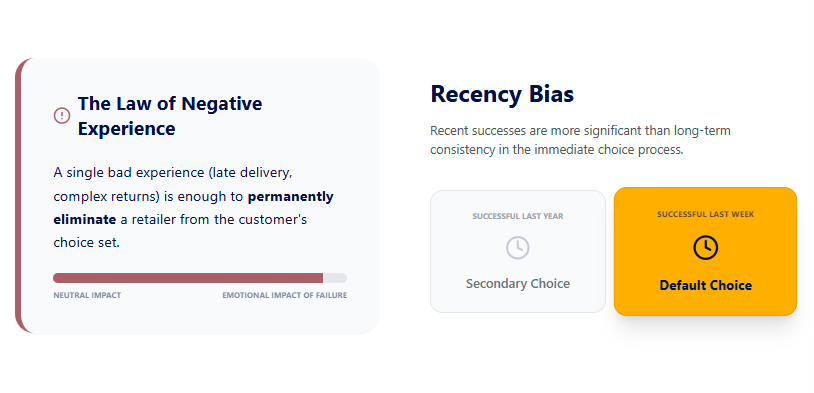
On the other hand, negative experiences provoke a much stronger reaction in the opposite direction. A single bad experience such as late delivery, bad customer service, or a complicated return process can result in the customer permanently eliminating that retailer from their choice set.
Since the psychological impact of negative events is greater than that of positive events of the same magnitude, it is the failure of customer service that hits the hardest.
The latest event of experience is more significant than people realize on a conscious level. For example, a retailer that has been working successfully for the last week is a more immediate choice than one that has been successful for the last year.
This recency bias implies that customer loyalty is obtained through continuous positive transactions and not only through the absence of problems. In this way, retailers should keep their customers coming back for more purchases and use marketing to not get out of the customers’ minds.
Social Proof and Recommendation Influence
Word, of, mouth recommendations from friends or family who are trusted still have a great impact in choosing a retailer. A personal recommendation such as, “I always buy from them and never have problems, ” is a very credible endorsement that no amount of advertising could ever equal. These kinds of peer recommendations are of great significance especially when the recommender is familiar with the category or has relevant experience.
Online reviews are a way of collecting social proof from a large number of people. A retailer with tens of thousands of positive reviews is, in effect, showing a proven track record that will convince even total strangers of his or her reliability in a way that was not possible before the advent of the internet. This stock of social proof is not only helping new retailers gain trust but also is a source of increasing returns for the ones that are already established.
Recommendations by influencers operate pretty much on the same principles but they have social trust as a parasocial element on top of that. The followers who think they know an influencer through his/her regular posts to their feeds end up giving some of their personal trust to that influencer’s recommendations. This is a very effective method with the younger audience who are more at ease with the digital, native types of social proof.
Category-Specific Decision Patterns
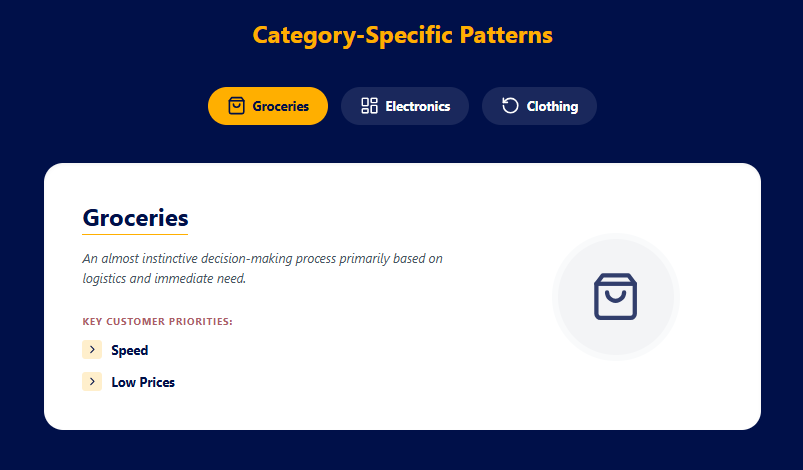
Different product categories stimulate different customer decision, making processes to a great extent. When it comes to grocery shopping, the main focus is on getting the things quickly and at the lowest possible price.
Whereas, buying electronics involves thorough investigation and checking a variety of features. Clothing, on the other hand, is directed by the product return and fitting policies mainly. Getting to know such pattern differences per category helps to comprehend why the majority of retailers are not capable of dominating all the categories at once.
A situation where price and delivery become the only deciding factors is when commodities are involved here differentiation is at a minimum. If everyone is selling the same branded item, then there is hardly any justification for paying more or waiting longer. Such categories are bound to become race, to, the, bottom competitions unless retailers come up with other sources of value.
Complex buying decision, which may require consultation or product customization, would naturally go to the category, leading retailer with the necessary product knowledge. A person buying technical equipment, the specialized tools, or the products in which the knowledge to choose the right one is the main value he or she is placing on the experts rather than the price only.
Generalist retailers have a hard time competing in these types of categories against the specialists who offer real guidance.
The Path Forward for Retailers
It is by recognizing the real consumer choice mechanisms that companies can locate their areas of competitive advantages, rather than relying on idealized marketing models. Price is important, however, only when it is within a band of acceptability which is primarily determined by trust, convenience, and experience. Retailers whose only weapon is price are essentially fighting the toughest battle and at the same time with the smallest margins.
By building trust, removing friction, providing consistently enjoyable experiences, and remaining relevant through regular communication, a company forms strong advantages that can withstand price competition. These factors work together over time;
retailers who master them enjoy increasing customer loyalty, while those who do not constantly lose customers despite their pricing strategies. The way these choices are made explains why some internet retailers are very successful while others are finding it hard to get a foothold, even though their products seem to be competitively priced.