
Consistently producing articles, newsletters or product descriptions takes time. AI writing tools can speed up brainstorming, outlining, drafting and rewriting. However, they cannot replace human expertise, fact-checking or editorial judgement. To produce useful content that aligns with your brand, artificial intelligence must remain an assistant. This guide outlines a clear methodology, the best tools to use and a quality control checklist to review before publishing.
What is AI text generation ?
AI writing involves using an artificial intelligence tool to prepare, generate or improve written content. It can be used before drafting, during the writing process or when editing.
An AI writing assistant relies on a language model. This system analyses your prompt, the provided information and the expected output format to generate coherent text. The quality of the result therefore depends heavily on the context you provide. A basic instruction such as “write an article about marketing” will often produce generic content. A detailed brief specifying the target audience, objective, sources, tone and structure will yield a much more usable result.
AI-assisted writing is not limited to generating paragraphs. It can help identify topics, compare different angles, organise ideas or summarise documentation. It can also rewrite a section, simplify an explanation or adapt a blog post into a LinkedIn update.
You should not delegate every decision. The tool does not automatically know your experience, your market positioning or your clients’ exact expectations. It may also produce inaccurate, outdated or fabricated information. The human writer remains responsible for the sources, arguments, examples and final validation.
The most effective approach is a collaboration. AI speeds up repetitive tasks. The human provides the strategy, nuance, credibility and personality that make the content genuinely useful.
How much time does AI writing actually save ?
The time saved depends less on the chosen tool and more on how you integrate it into your editorial workflow. Artificial intelligence is particularly effective when the work is broken down into clear steps.
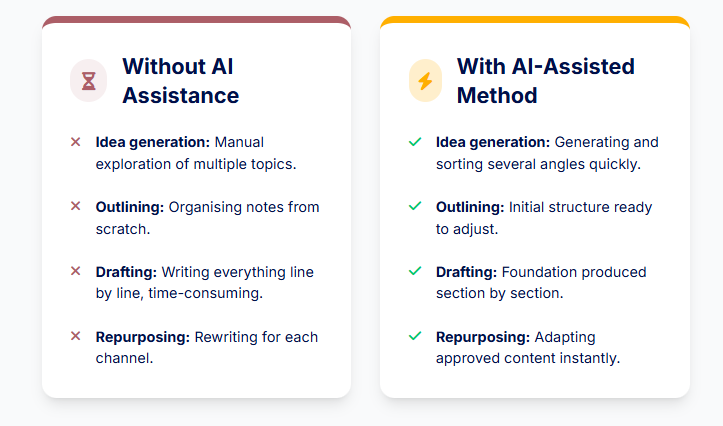
It can accelerate brainstorming by suggesting multiple topics or angles. It also reduces the time needed to transform messy notes into a structured outline. During the drafting phase, it provides an initial version that the professional can correct and personalise. Finally, it makes it easier to repurpose long-form content into a summary, newsletter, social media post or video script.
The results are less convincing when you simply ask for a full article using a vague prompt. The resulting text often feels generic, repetitive or disconnected from your brand voice. The supposed time saved is then lost removing clichés, fact-checking claims and rewriting entire passages.
A strong workflow therefore involves preparing your sources and brief before prompting the tool. You should then draft the content section by section. This organisation allows you to control the direction of the piece and quickly correct any deviations.
| Step | Without AI assistance | With an AI-assisted method |
| Idea generation | Manual exploration of multiple topics | Generating and sorting several angles |
| Outlining | Organising notes from scratch | Initial structure ready to adjust |
| First draft | Writing everything line by line | Foundation produced section by section |
| Proofreading | Correcting substance and format | Checking facts, style and added value |
| Repurposing | Rewriting for each channel | Adapting approved content |
There is no universal percentage of time saved. With a clear brief, reliable sources and a structured method, you can drastically reduce preparatory tasks. Conversely, improvising your approach can make production take longer. The real benefit is freeing up more time for research, expertise and improving the final content.
8 steps to create content faster with AI
Artificial intelligence saves time when it fits into an existing, structured process. The most effective method is not to request a full article in a single command. Instead, you should advance step by step. Each phase reduces errors and makes it easier to validate the output.
1. Define the content objective
Start by clarifying what the content needs to achieve. An article might inform, attract traffic, generate leads or help a prospect make a decision. The objective influences the angle, the level of detail and the call to action.
You should also specify the expected format. An educational guide is not structured like a product description or a LinkedIn post. The more precise your objective, the less likely the AI is to produce generic copy.
2. Identify the reader and their search intent
Describe the person you are addressing. Specify their level of knowledge, their main problem and the answer they hope to find.
For SEO content, do not stop at the keyword. Try to understand why the user is making this search. Do they want to learn, compare solutions or take action? This intent must guide the structure and depth of the text.
You can ask the AI to suggest several possible intents. The final decision, however, must rely on analysing search results and knowing your audience.
3. Compile reliable sources
Gather the necessary information before you start writing. Use internal documents, studies, official pages or verifiable data. You should also add your own examples, observations and company-specific details.
The AI can organise these sources. It must not, however, fill in missing information by inventing facts. Ask it to flag uncertain points rather than producing a rough guess.
This step significantly reduces fact-checking time and improves the accuracy of the first draft.
4. Request multiple editorial angles
The same topic can be approached from different angles. Ask the AI to suggest several options suited to your target audience and objective.
For an article on AI writing, it might suggest a tool comparison. Other options could include a step-by-step method or an analysis of common mistakes. Compare these proposals based on their usefulness, originality and alignment with search intent.
Do not automatically accept the first idea. The purpose of this phase is to broaden your options before choosing the most relevant direction.
5. Create a detailed outline
Next, request a structure outlining the main sections, the questions to answer and the examples to include.
A good outline must follow a logical progression. It prevents repetition and helps identify weak sections before you start drafting.
Ensure every heading introduces distinct information. Merge subsections if they are only likely to contain a few sentences. The outline should organise your argument, not artificially inflate keyword usage.
6. Draft the content section by section
Avoid generating thousands of words in a single prompt. Provide the AI with the general outline. Then, request each section separately, specifying its objective, word count and the information to use.
This method makes editing easier. If a passage feels too generic, you can rewrite it without altering the whole article. It also gives you better control over the tone, examples and transitions.
Review each block before continuing to ensure the same ideas do not reappear later.
7. Humanise and enrich the draft
The initial text generated is a foundation, not a publish-ready version. Add your experiences, examples and opinions. Replace generic phrasing with specific observations.
You must also verify that the text matches your brand voice. Feeding the AI previously approved content can help it replicate the desired language level and rhythm.
Adopting a hybrid AI and human writing approach allows you to maintain production speed without sacrificing expertise and personality.
8. Review, optimise and publish
Check every data point, quote and feature mentioned. Remove repetition and ensure the main answer appears early on.
Next, optimise the headings, internal links and readability. The AI can also help adapt the approved content into a newsletter or social media post. For regular output, certain editorial workflows can be automated. Final approval, however, must remain human. This last step transforms a quick draft into reliable, useful content that aligns with your strategy.
The best AI writing prompts to copy
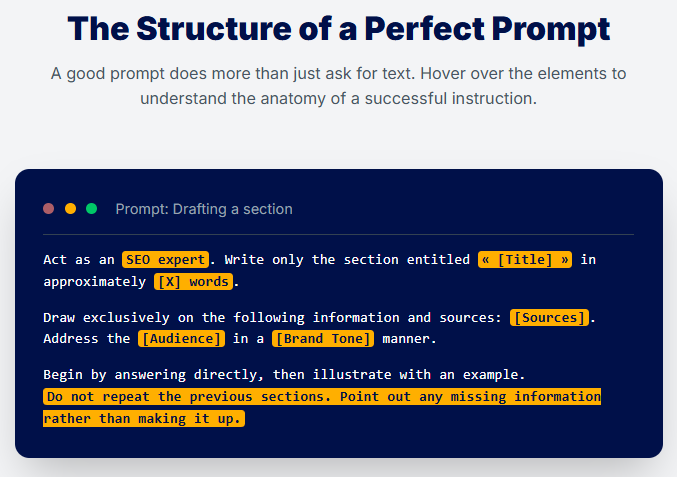
A good prompt does more than just ask for text. It provides the AI with an objective, an audience and your sources. It also includes constraints and an output format. The templates below must therefore be personalised with your information.
Prompt for generating content ideas
Use this template to explore a topic without immediately generating an article.
Act as an editorial strategist specialising in [industry]. Suggest 10 content ideas for [audience]. The objective is to [objective]. For each idea, indicate the problem addressed, the recommended angle and the search intent. Also include the original value to provide. Avoid generic topics and do not present any unverified data as fact.
Replace the variables in brackets. Then, ask the tool to rank the ideas by utility, originality or commercial potential.
Prompt for analysing search intent
This prompt helps you go beyond simply repeating a keyword.
Analyse the intent associated with the query « [keyword] ». Identify the reader’s main question, their secondary questions and their level of knowledge. You should also determine the result they want to achieve. Distinguish between informational, comparative and transactional intents. Flag any elements that need verification in current search results.
The resulting analysis remains a hypothesis. Compare it with the pages that actually rank before finalising your angle.
Prompt for creating an SEO outline
Build a detailed outline for an article targeting « [keyword] ». The audience is [audience] and the objective is [objective]. Organise the H2s and H3s in a logical progression. For each section, specify the question to address, useful examples and an indicative word count. Merge any weak subsections. Do not invent statistics and flag information that requires a source.
Request several outline variants rather than automatically accepting the first structure.
Prompt for drafting a section
Write only the section entitled ‘[title]’ in approximately [word count] words. Draw exclusively on the following information and sources: [sources]. Address [audience] in a [tone] manner. Begin by answering the question directly, then expand on your answer using a method or an example. Do not repeat the previous sections. Point out any missing information rather than making it up.
Drafting section by section makes it easier to control the substance, style and word count.
Prompt for humanising and improving text
Revise the text below without altering its meaning. Remove generalisations, repetitions and awkward transitions. Make the sentences sound more natural and precise. Retain any necessary technical terms, but explain them simply. Adhere to this brand voice: [rules and examples]. Flag any statements that require verification. Do not invent any examples or results that are not provided.
This final prompt does not replace human proofreading. Its main purpose is to spot weak passages and produce alternatives.
Training your teams on artificial intelligence tools can be useful when multiple colleagues need to share the same briefing, writing and validation rules.
Which AI writing tools should you choose?
No single tool is automatically the best for every use case. Some are versatile, while others focus on SEO, brand consistency or proofreading.
ChatGPT is suitable for brainstorming, outlining and progressive editing. Its Projects spaces let you group files and conversations together, while Canvas is designed for co-writing and editing long-form content.
Claude is particularly well-suited for work based on a set of documents. Its Projects feature can combine a knowledge base with multiple conversations. Artifacts isolate long-form content in a separate space to make it easier to view and edit. However, certain features depend on your subscription tier.
Gemini can assist with drafting, brainstorming and planning. Its Canvas space allows you to create or modify documents, while Deep Research can conduct research using Google Search and user-provided sources.
Jasper caters more to marketing teams looking to align multiple pieces of content. Its brand voice management feature lets you define the tone, style and certain formatting or editorial rules.
Notion AI is interesting when briefs, notes and documents are already centralised in Notion. You should also consider it if you have existing knowledge bases there. The assistant can generate or transform content directly within this environment and use workspace information depending on your configuration.
Grammarly is primarily useful for correcting, rephrasing and adjusting tone. It is also helpful for generating short passages in the environments where the user is already writing. Its generative assistance can compose, rewrite and suggest ideas while taking context into account.
Surfer focuses its features heavily on AI writing for SEO and optimisation. Its Content Editor provides recommendations based on analysing ranking pages, while its tools can assist with rephrasing and tone adaptation. These recommendations must remain guidelines, not a list of terms to insert mechanically.
| Tool | Main use | Key strength | Limitation to anticipate |
| ChatGPT | Ideas, outlines, drafting and editing | Process versatility | Generic output without a precise brief |
| Claude | Long documents and source analysis | Working within a documentary context | Features vary by plan |
| Gemini | Research, planning and drafting | Integration with the Google ecosystem | Sources always require checking |
| Jasper | Team marketing production | Brand voice consistency | Less relevant for occasional needs |
| Notion AI | Documentation and internal content | Working in a centralised space | Limited value outside Notion |
| Grammarly | Correction and rephrasing | Works within writing tools | Less suited for a complete guide |
| Surfer | SEO-focused content | Helps with semantic coverage | Risk of over-optimisation |
Features and access conditions may change. Check the documentation and available plans before choosing a solution.
How to choose your AI writing tool ?
Start by identifying your primary need. To research, structure and draft various formats, a versatile assistant is usually enough. A team needing to produce a lot of consistent content will likely prefer a tool with brand voice and collaboration features. For regular SEO work, a specialised platform can complement the generalist assistant.
Next, evaluate the quality of the language output, source management and the ability to upload your own documents. You should also examine integrations, privacy and the actual cost for the number of users involved.
| Your situation | Preferred solution |
| You occasionally write various formats | Versatile assistant |
| You work from numerous documents | Tool with projects and knowledge base |
| The whole team already uses the same workspace | Assistant integrated into that environment |
| You need to maintain several brand voices | Marketing-oriented platform |
| You primarily edit existing text | Revision assistant |
| Your priority is SEO optimisation | Specialised SEO tool paired with human proofreading |
Avoid stacking subscriptions right from the start. Test a complete process with a primary tool and measure the limitations you encounter. You can then add a specialised solution only when it meets a real need. A structured AI writing approach should first improve workflow quality, not multiply your software.
How to maintain your style and avoid robotic text ?
Generated text becomes recognisable when it relies heavily on generalities, predictable transitions and flat conclusions. To avoid this result, the AI must receive more than just a simple instruction on tone. It needs concrete rules and representative examples.
Build a comprehensive brand voice guideline
Define how your brand speaks. Specify the level of language, typical sentence length and the importance given to examples. You should also clarify how you address the reader. Add preferred expressions, terms to avoid and key editorial stances.
An instruction like “adopt a professional tone” remains too vague. Instead, specify that the text must be educational, direct and accessible to a non-specialist executive. Request short paragraphs, concrete explanations and an absence of overblown promises.
Next, provide two or three previously approved pieces of content. The AI can then observe their rhythm, vocabulary and level of precision. Ask it to identify common characteristics before writing to ensure it has fully understood the desired voice.
Enrich the draft with what AI lacks
Even when well-phrased, a first draft often remains interchangeable. Make it stand out with an error encountered on a project, a frequent objection or a method actually used by your team.
You should also replace vague claims with observable situations. “AI improves productivity” adds little value. Explaining that it can transform an expert interview into an article outline, and then into a newsletter, makes the benefit much more concrete.
Finally, remove general introductions, strings of synonyms and repetitive transitions. Check conclusions that merely summarise without offering a clear decision. A strong edit reinforces the perspective, precision and utility of the text.
AI writing and SEO: How to produce faster without creating empty content
AI can facilitate research, structuring and rephrasing. It does not, however, exempt you from identifying search intent or providing an original answer. Google clarifies that using AI is not inherently problematic. On the other hand, generating numerous pages with no added value can be considered scaled content abuse.
Start with the reader’s needs
First, formulate the main question the page needs to answer. Next, identify the secondary questions required to fully understand the topic or make a decision. This hierarchy prevents you from adding sections simply because a tool recommends a keyword.
Place the core answer at the beginning of each section. Then, expand with a method, an example or a nuance. This organisation improves readability and allows a passage to be understood without relying on several preceding paragraphs.
On-page SEO optimisation comes into play once the substance is established. It helps clarify the title, subheadings, links and descriptive elements, but it does not replace the quality of the information.
Add value that AI cannot reconstruct alone
Competitive content does more than just summarise pages that already rank. Add internal data, a test, a documented comparison or a specialist’s opinion. You can also present a process, a checklist or a case study created specifically for the topic.
Check every data point and trace it back to the original source whenever possible. A claim repeated across multiple articles may stem from the same incorrect information. Therefore, ask the AI to distinguish between sourced facts, hypotheses and recommendations.
Prepare content for generative engines
Fundamental SEO practices remain relevant for generative search experiences. Above all, Google recommends reliable, useful, original and clearly structured content. It also specifies that no special file or markup designed solely for large language models is required to appear in its generative features.
Draft precise definitions and clearly name the tools, methods or concepts you mention. Use tables when a comparison is useful and indicate the limits of a recommendation. An Answer Engine Optimization approach can help organise more direct answers, provided it remains integrated into a coherent, reader-focused SEO strategy.
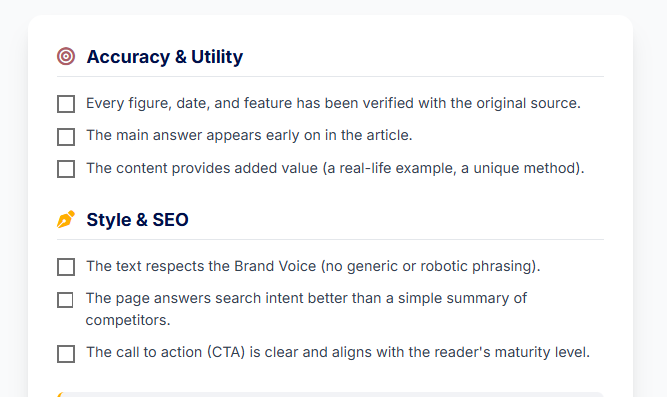
Pre-publication quality control checklist
Use this checklist after writing and before publishing. AI can assist with the review process, but final approval must remain human.
Accuracy
- Has every figure, date and feature been verified?
- Are the sources sufficiently recent and reliable?
- Does the text distinguish between facts, estimates and advice?
- Do proper nouns match the original documents?
Utility
- Does the main answer appear early on?
- Does each section genuinely help the reader?
- Does the content provide an example, a method or original information?
- Can certain passages be removed without losing meaning?
Style
- Does the text respect the brand voice?
- Have generic sentences and repetition been removed?
- Do the transitions feel natural?
- Do the examples reflect realistic situations?
SEO
- Does the title accurately reflect the content?
- Do the subheadings follow a logical progression?
- Are the primary keyword and its variants used naturally?
- Do the internal links genuinely help the reader?
- Does the page answer the search intent better than a simple summary of competitors?
Conversion
- Does the reader understand the next step?
- Does the call to action align with their maturity level?
- Does the commercial promise remain consistent with the content?
- Are the stated benefits demonstrated rather than exaggerated?
This final review transforms a quick draft into publishable content. It must correct errors, but also remove anything that makes the text interchangeable.
The limits and risks of AI writing
A tool’s speed guarantees neither the accuracy nor the originality of the output. A writing assistant can produce a convincing response while mixing accurate, outdated or fabricated information. You must therefore check every figure, quote and feature before publication. Reference checks are also essential.
The risk increases when the prompt asks the AI to fill in missing information. It is better to ask it to flag missing or uncertain data. This rule is particularly important for legal, medical, financial or technical topics.
Standardisation is another danger. The same structures, transitions and examples reappear when multiple pieces of content are produced using similar instructions. The text becomes correct, but interchangeable. To differentiate it, add an internal method, a real-life experience or a test. A well-argued viewpoint can also help.
Caution is also required regarding confidential data. Do not upload client files, personal information or strategic documents without checking the tool’s privacy policies. You should also verify the settings of the account you are using.
Finally, AI can create dependency. A team that can no longer build an angle or verify an argument without an assistant gradually loses its autonomy. The goal must remain speeding up repetitive tasks, not abandoning editorial skills.
Mass production represents the final pitfall. Generating numerous similar articles does not automatically build authority. Useful content must provide a specific answer, proof or a perspective that the reader cannot find everywhere else.
Can AI replace a human writer ?
AI can handle a significant portion of the preparatory work. It can generate ideas, organise notes and suggest a first draft. It remains limited, however, when it comes to understanding a complex situation or defending a position. It also struggles to transform a real experience into a credible narrative.
| Skill | Artificial intelligence | Human writer |
| Idea generation | Fast and abundant | More selective and contextualised |
| Outlining | Effective with a good brief | Able to arbitrate based on strategy |
| First draft | Very fast | Slower, but often more intentional |
| Fact-checking | Uneven depending on available sources | Can trace sources and judge their reliability |
| Brand voice | Possible imitation based on examples | Finer understanding of the context |
| Experience and opinion | Possesses no real-life experience | Brings expertise, perspective and a clear stance |
| Final approval | Can suggest corrections | Assumes editorial responsibility |
The best setup therefore combines both. AI prepares, structures and rephrases. The writer chooses the angle, verifies the information and adds what gives the content its unique value.
This SEO web writing approach saves time without reducing editorial work to automated text generation. The professional’s role evolves towards more strategy, oversight and enrichment.
Examples of content to produce faster with AI
AI does not save the same amount of time for every format. It is mostly useful when the content relies on a clear brief, readily available information and a relatively predictable structure.
Blog posts
The tool can suggest angles, analyse the reader’s questions and build an outline. It can then generate a first draft section by section. The writer must check the sources, remove repetition and add examples drawn from their expertise.
LinkedIn posts
An article, an interview or meeting notes can serve as raw material. The AI can suggest several hooks, condense the message and adjust its length. The human chooses the perspective, adds a personal observation and ensures the text does not feel like a generic post.
Newsletters
The assistant can summarise long-form content, write an email subject line and organise the message around a main benefit. It can also produce several variants depending on the reader’s maturity level. Information selection and the core promise remain under human control. A solid newsletters and email sequencing strategy also requires consistency between the message, the target audience and the desired action.
Product descriptions
Using verified specifications, AI can transform technical documentation into a more accessible description. It can also adapt the benefits for different buyer profiles. You must, however, check every dimension, material, compatibility detail and promise. No product advantage should be invented.
Video scripts
AI can convert an article into a short script, simplify sentences and suggest a hook. It also makes it easier to create variants for different social networks. The speaker must then adapt the rhythm to their speaking style and remove hard-to-pronounce phrasing. They also need to ensure the script fits within the planned timeframe.
For all these formats, the method remains similar. The professional provides the information and defines the objective. The AI prepares a foundation. The human then selects, corrects and adds the value the tool cannot produce alone.
Case study: Creating an article with AI from start to finish
Consider an SME that wants to publish an article titled “How to reduce the time spent creating newsletters”. The goal is to attract marketing managers and guide them towards an editorial support solution.
An overly vague initial prompt
The company starts with this instruction:
Write a blog post about using AI to create newsletters faster.
The tool produces grammatically correct but very broad text. The introduction states that artificial intelligence is transforming marketing. The sections list a few benefits and then recommend choosing a good tool. No specific audience is identified, and no examples differentiate the content. The problem is not just the AI. The request lacks an objective, sources and an editorial angle.
A more precise brief and prompt
The team then prepares a brief including:
- the reader’s profile
- current production steps
- difficulties encountered
- available examples
- the expected action after reading
They then submit this instruction:
Act as a B2B copywriter specialising in content marketing. Prepare an article for SME marketing managers who produce a monthly newsletter. The objective is to explain how to use AI to speed up brainstorming, outlining, drafting the first version and creating email subject lines. Do not present AI as fully autonomous. Emphasise fact-checking, brand voice and human validation. Rely only on the provided notes. Start by suggesting three angles and a detailed outline.
This time, the tool suggests several approaches. The team selects an angle focused on a repeatable workflow rather than a software comparison.
Creating the outline and first draft
The chosen outline follows a simple progression:
- prepare the topic and sources
- produce multiple angles
- write the core message
- create subject line variants
- check the tone and information
- analyse the results to improve the next edition
Each part is then generated separately with a specific word count. This method stops the AI from repeating the same promise across multiple sections.
The first draft is usable, but it still contains vague expressions like “save precious time” or “revolutionise your strategy”. These phrases are removed.
Human corrections and enrichment
The team adds an example from their own process. Instead of just claiming that AI speeds up writing, they explain how a client interview transcript can be turned into three newsletter angles.
They also note that suggested subject lines should be compared against past campaign performance. Overblown promises are removed, and every company-specific detail is verified.
The final content therefore relies on more than just generation. The AI organised the notes, suggested the outline and produced a foundation. The team provided the context, examples and editorial decisions.
The result and actual time saved
In this educational example, the time savings are concentrated on outlining, drafting the first version and creating variants. Sourcing information, adding experience and final validation remain necessary.
The time saved should not be presented as a universal guarantee. It depends on the quality of the brief, the complexity of the topic and the level of editing required. A structured approach nevertheless allows you to spend less time staring at a blank page and more time improving the content.
AI writing FAQ
What is the best AI writing tool ?
There is no single best tool for every need. A versatile assistant is suitable for research, outlining and the first draft. A specialised tool might be better for proofreading, SEO or managing a brand voice across a team.
Are there free AI writing tools ?
Several assistants offer free access with limits on volume, features or models. Conditions change regularly. Always check current offers and test the tool on a complete workflow before subscribing.
How do you write an article with ChatGPT ?
Start by providing the audience, objective, sources and expected format. Ask for several angles, then an outline. Next, have it draft each section separately. Fact-check the output, add your examples and do a full proofread before publishing.
How can you make AI text sound more natural ?
Give the tool examples of previously approved content and a precise brand voice guideline. Ask it to remove generalities, repetition and mechanical transitions. Since adding real experience remains essential, Honadi refines your generated text to ensure a 100% natural and engaging result.
Does Google penalise AI-generated content ?
Google does not consider the use of AI a violation in itself. Its policies mainly target content produced at scale with no value for the user. To secure your traffic, Honadi ensures every published piece remains useful, original and strictly compliant with anti-spam guidelines.
Can AI writing be used for SEO ?
Yes, particularly for analysing user questions, structuring outlines and improving readability. The tool must not, however, dictate the content mechanically. To combine automation with performance, Honadi applies the best SEO practices to guarantee your visibility on Google.
How do you fact-check AI-generated information ?
Identify every verifiable figure, date, quote or feature. Trace them back to the original source and check the publication date. If the information remains uncertain, remove it or present it explicitly as a hypothesis.
Should you disclose that content was written with AI ?
There is no universal answer for all content. Transparency may depend on the context, the contract, the platform or the industry. Google advises considering a disclosure when a reader might reasonably wonder how the content was created.
Can AI replicate a brand voice ?
It can come close with precise guidelines and counter-examples, but the result still needs checking. To maintain a strong editorial identity over time, our agency deploys an expert hybrid method combining AI and human creativity.
Will AI replace web copywriters ?
It automates preparation and rephrasing, but strategy, experience and editorial responsibility remain human. Far from disappearing, Honadi’s expertise now focuses on steering and strictly reviewing your web content.
Conclusion
AI writing allows you to produce faster when integrated into a clear method. Prepare your brief, gather your sources and develop the content section by section. Next, use a human review to fact-check, preserve your brand voice and add genuine editorial value.
The goal is not to publish more generic text. It is to reduce the time spent on repetitive tasks so you can focus on the angle, examples and utility of the content. Start by testing this process on a single format. You can then adjust your prompts and validation rules before scaling it up.