
Creating content in minutes, personalising campaigns at scale and analysing thousands of data points instantly used to be capabilities reserved for large corporations. Today, artificial intelligence tools make them accessible to organisations of any size, and they can also help automate repetitive tasks.
This enthusiasm comes with a major challenge. The market is flooded with conversational assistants, image generators and workflow automation platforms. With AI-enriched CRMs and hundreds of new software releases each year, telling genuine opportunities from passing trends has become increasingly difficult.
However, adopting AI does not mean multiplying subscriptions or systematically replacing your existing methods. An effective strategy relies on choosing the right tools and integrating them smoothly into your business processes. It requires a thoughtful approach designed to serve specific marketing objectives.
This comprehensive guide first explores what AI marketing actually is and why it has become a strategic asset for businesses. We will then review its main use cases, outline the best tools for your needs and detail the criteria for making the right choices. Finally, you will learn how to deploy AI within your strategy, measure its return on investment and avoid the most common mistakes.
What is AI marketing?
AI marketing refers to the artificial intelligence technologies used to improve marketing performance. It helps analyse large amounts of data, generate content and personalise customer interactions. It also automates repetitive tasks. Its goal is not to replace marketing teams. Instead, it helps them make better decisions and execute high-value actions much faster.
Since the arrival of widely accessible generative AI models like ChatGPT and Gemini, AI marketing has become much more than a simple automation tool. It now plays a role at almost every stage of the customer journey. This ranges from competitive research to customer retention. It also covers content creation, SEO, advertising campaigns and performance analysis.
However, not all platforms work the same way. Understanding the main categories of AI helps you choose the right tools for your needs and avoid unnecessary investments.
The four main types of AI used in marketing
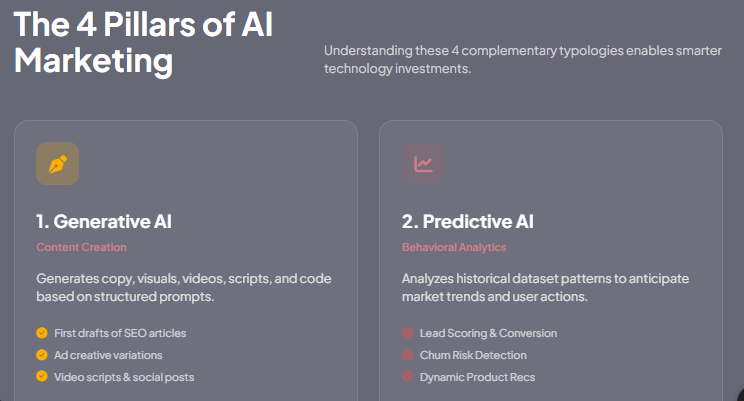
When people talk about AI marketing, they often think of conversational assistants capable of writing text or answering a question. In reality, these tools only represent one part of the ecosystem. Businesses today use four main categories of artificial intelligence, and each one meets different needs.
Generative AI
Generative AI produces new content based on instructions called prompts. It can write articles, create images and generate videos. It can also write code or suggest campaign ideas.
This is currently the most widely known category thanks to tools like ChatGPT, Claude and Gemini.
Common use cases include:
- Drafting the first version of a blog post.
- Creating multiple variations of an advertisement.
- Generating social media posts.
- Writing a video script or an email sequence.
Generative AI significantly speeds up the production phase. However, it always requires human validation to verify information, maintain the brand’s tone and guarantee a quality result.
Predictive AI
Unlike generative AI, predictive AI does not create content. It analyses historical data to anticipate future behaviour.
For example, it can estimate:
- The likelihood that a prospect will become a customer.
- The risk of a customer leaving the company.
- The products likely to interest a buyer.
- The periods when sales will be highest.
CRM platforms, e-commerce solutions and advertising tools already make extensive use of these algorithms to improve campaign performance.
Intelligent automation
This category combines business rules with artificial intelligence to automatically execute specific tasks.
In practical terms, a workflow can be configured to:
- Summarise form responses.
- Qualify a prospect automatically.
- Send a personalised email.
- Create a task in project management software.
The goal is not just to save time. Well-designed automation also reduces manual errors and ensures more consistent process execution. When a business wants to move beyond a few isolated automations, setting up intelligent workflows to automate repetitive tasks often becomes a foundational step.
AI agents
AI agents represent one of the most significant developments in recent years. Unlike a conversational assistant that waits for a specific instruction, an agent can string together several actions to achieve a goal.
For example, you might ask an agent to prepare a report on your weekly advertising campaigns. Instead of simply answering a question, it can retrieve data from several platforms, analyse it and produce charts. It can then write a summary and automatically send the document to your team.
These agents remain supervised by humans, but they pave the way for much more advanced automation of marketing processes.
AI marketing vs marketing automation: what is the difference?
These two concepts are often confused, but they follow different logics.
Marketing automation involves automating actions based on predefined rules. For instance, when a visitor downloads a white paper, they automatically receive a scheduled series of three emails.
AI marketing adds an ability to analyse and adapt. It can modify the message content based on the prospect’s profile, determine the best time to send it or recommend a different product based on observed behaviour.
| Marketing automation | AI marketing |
| Follows predefined rules | Learns from data |
| Triggers automatic actions | Can recommend or generate actions |
| Limited personalisation | Dynamic personalisation |
| Runs on fixed scenarios | Adapts to observed behaviour |
In practice, top-performing businesses now combine both approaches. Automated scenarios ensure process consistency, while artificial intelligence improves their relevance through data analysis.
What AI marketing can do… and what it should not do alone
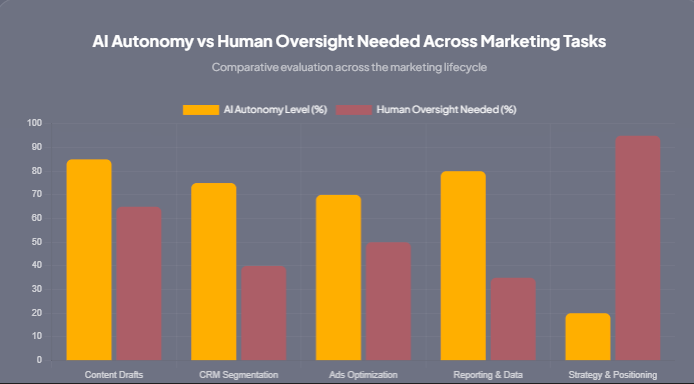
Artificial intelligence excels at processing large volumes of information and speeding up repetitive tasks. It can analyse thousands of customer reviews in minutes, generate several text variations or identify trends that are hard to spot manually. Conversely, certain decisions must remain in the hands of human experts.
For example, defining a brand’s positioning, allocating a major budget or managing crisis communication requires a deep understanding of context. It involves commercial stakes and emotional nuances that AI models do not fully master.
An effective approach involves dividing responsibilities:
| AI is particularly useful for… | Human oversight remains essential for… |
| Analysing data | Defining marketing strategy |
| Generating drafts | Approving sensitive messages |
| Personalising content | Ensuring brand consistency |
| Automating tasks | Making major decisions |
| Spotting trends | Controlling quality and accuracy |
This complementary dynamic explains why advanced companies do not try to replace their marketing teams. They equip them with tools capable of improving productivity while maintaining human control over strategic decisions. Furthermore, adopting a comprehensive strategy for digital transformation and AI helps identify use cases that truly create value before adding new software.
Why are all businesses adopting it?
Artificial intelligence is no longer reserved for large corporations with dedicated data science teams. Today, an SME, an online store, an agency or a freelancer can integrate AI tools into their daily operations without investing in complex infrastructure. This democratisation explains why AI marketing has become a strategic priority for organisations of all sizes.
Businesses are not just trying to produce more content. Above all, they want to make better decisions, leverage their data more effectively and offer a highly personalised customer experience. When used thoughtfully, AI acts as a performance accelerator rather than a simple productivity tool.
Benefits that go far beyond saving time
Saving time is often the first advantage mentioned. It is a real benefit, but it only represents a fraction of the value.
AI also improves analytical quality, spots opportunities faster and personalises interactions at scale.
For instance, an e-commerce site can use AI to automatically recommend products based on each visitor’s purchase history. Meanwhile, a B2B company can prioritise the prospects most likely to convert even before a sales representative contacts them.
The main benefits include:
| Need | AI contribution |
| Producing more content | Assisted generation of text, images or video |
| Understanding customers better | Behaviour analysis and finer segmentation |
| Optimising campaigns | Continuous adjustment of bids, audiences or creatives |
| Improving customer experience | Personalised messages and recommendations |
| Deciding faster | Dashboards enriched by predictive analysis |
However, these results remain closely tied to the quality of available data and the way teams use the tools.
Adoption across all marketing roles
Initial use cases were primarily focused on copywriting. Now, virtually every marketing function can benefit from artificial intelligence.
An SEO team can speed up keyword research and identify content opportunities. A CRM manager can automate contact base segmentation. Advertising teams already rely on algorithms capable of optimising bids in real time, while community managers use AI to adapt their posts to different social networks.
This evolution shows that AI is no longer an isolated tool. It is gradually becoming a core component of overall digital strategy. Before piling on new solutions, however, it is advisable to conduct an AI audit to identify the most relevant processes to automate and the tools that truly match the company’s goals.
The limitations to know before you start
Enthusiasm for AI can sometimes lead to unrealistic expectations. No solution produces perfect results every time.
Generative models can invent information, misinterpret context or produce overly generic content. Predictive systems, on the other hand, remain dependent on the quality of their underlying data.
Certain limitations come up regularly:
- Answers may contain factual errors.
- Generated content always requires proofreading.
- Sensitive data must be protected.
- Costs can rise quickly when multiple subscriptions pile up.
These constraints do not negate the value of AI. They simply serve as a reminder that a successful project relies as much on methodology as it does on technology.
Why 2026 marks a turning point ?
The year 2026 is defined by a major shift. Businesses no longer just use assistants capable of answering a question. They are starting to deploy systems that can execute multiple coordinated tasks.
AI agents, advanced automations and multimodal tools are gradually transforming working methods. At the same time, search engines are evolving with the rise of AI-generated answers, pushing marketing teams to adapt their visibility strategies.
This transformation is therefore not just about adopting new software, but about rethinking specific workflows. Companies that also invest in training teams on digital tools and AI generally achieve faster adoption and more sustainable results than those that focus solely on the technology.
Key figures to remember
Even though adoption rates are changing rapidly, several trends stand out:
- AI is now used by businesses of all sizes, not just large corporations.
- The most common use cases involve content creation, customer service and data analysis.
- Organisations that define a deployment strategy before choosing their tools generally achieve a better ROI than those that adopt them on the fly.
These observations show that the challenge is no longer deciding whether to use AI, but how to integrate it coherently into a broader marketing strategy.
The best use cases for AI marketing
A company does not need to use artificial intelligence in all its processes to see benefits. The most profitable projects usually start with a clearly identified need. They then gradually expand to other activities once the initial results prove successful.
To better understand where AI brings the most value, it is helpful to follow the customer journey. This approach connects each technology to a concrete marketing goal rather than a passing trend.
Attracting prospects through better acquisition
The first step is to gain visibility and attract a qualified audience. Here, AI acts as an assistant capable of analysing a large volume of data to identify the most promising opportunities.
In search engine optimisation, it can help find topics users are searching for, structure content or analyse competitor pages. In digital advertising, it makes it easier to pinpoint high-performing audiences and helps optimise bids according to campaign goals.
Take the case of a B2B software company. Before launching a new Google Ads campaign, it can use AI to analyse prospect queries and identify search intents. It can then suggest several ad variations tailored to each segment.
Artificial intelligence also improves competitive intelligence by summarising publications, market developments or new content produced by key industry players.
When this approach is part of a comprehensive SEO and organic visibility strategy, AI recommendations become much more relevant. They are based on clearly defined goals rather than simple keyword generation.
Producing content faster without sacrificing quality
Content creation remains the most widespread use case today. Marketing teams use AI to speed up the production of articles, LinkedIn posts and newsletters. They also use it for product descriptions and video scripts. The goal is not to automatically publish everything the tool generates, but to reduce the time spent on initial drafts.
For example, a marketing manager can ask an AI to propose several article outlines or rewrite a paragraph. They can also ask it to create variations adapted to different social networks. The editorial work then consists of verifying the information, adding examples and adjusting the tone to fit the brand.
This collaboration between human and AI produces more content while maintaining high editorial quality. This is the very principle of hybrid AI and human copywriting, which combines the speed of generative models with a writer’s expertise.
Multimedia content follows the same logic. Image, video and voice generators make it easier to produce marketing campaigns. However, they always require creative oversight to preserve the brand’s visual consistency.
Optimising advertising campaigns
Advertising platforms have already been using artificial intelligence for several years. Google Ads and Meta Ads leverage algorithms that can adjust bids, identify top-performing audiences or automatically display the most effective creatives. AI also makes it possible to quickly test multiple variations of the same message.
Instead of creating a single advertisement, a marketing team can produce five different hooks, several descriptions and various visual proposals. The observed performance is then used to identify the most effective combinations.
This approach gradually reduces customer acquisition costs while improving the campaign’s return on investment.
To achieve lasting results, however, automation must remain driven by specific business goals. A continuous ROI optimisation process relies just as much on human analysis as it does on algorithmic recommendations.
Personalising customer relationships with CRM and email marketing
Every business today possesses a significant amount of data on its prospects and customers. The challenge is no longer collecting more information, but leveraging it better.
AI helps automatically segment a contact base according to behavioural criteria. It can detect the most engaged prospects or personalise email marketing campaigns.
Consider an online store as an example. Two customers buy the same product. The first orders regularly, while the second has not made a purchase in months. Thanks to predictive analysis, the two customers will receive different messages tailored to their likelihood of returning.
This personalisation generally improves open rates, clicks and conversions without increasing the volume of emails sent.
Retaining customers and improving the user experience
Acquisition is often the most visible part of marketing, but retention is an equally important growth lever.
Artificial intelligence can identify signals indicating a risk of churn. It can also recommend complementary products or automatically offer support tailored to each customer’s context.
Next-generation chatbots also go much further than simple automated replies. Connected to a CRM or a knowledge base, they can retrieve relevant information and guide a user throughout their journey.
For companies wanting to provide 24/7 support, integrating transactional AI chatbots is often an accessible first project before automating more complex processes.
Analysing performance to make better decisions
AI does not merely produce content or automate actions. It also helps you understand what is actually working.
Modern tools can consolidate data from multiple platforms, detect anomalies or automatically summarise the main trends observed.
Instead of manually analysing several dashboards, a marketing manager can receive a weekly summary highlighting the most important metrics. This report can point out growing campaigns and those requiring intervention.
This analytical capability allows teams to make decisions faster and focus their efforts on the actions that generate the most value.
| Customer journey stage | AI use case | Concrete example |
| Acquisition | SEO, advertising, intelligence | Identifying keywords and optimising campaigns |
| Content creation | Copywriting, images, video | Producing a first draft of an article or ad |
| Conversion | CRM, lead scoring, personalisation | Prioritising the most qualified prospects |
| Retention | Chatbots, recommendations | Suggesting offers based on customer behaviour |
| Analysis | Reporting, forecasting | Spotting trends and measuring performance |
All these use cases share one common trait. The best results do not come from using an isolated tool, but from combining several solutions integrated into a coherent marketing strategy. This is exactly what we will cover in the next section, which focuses on the main AI marketing tools and the criteria for choosing the best ones for your needs
The best AI marketing tools
The artificial intelligence tool market is evolving rapidly. Every month, new platforms emerge while existing solutions expand their features. This abundance can quickly become confusing, especially when equipping a marketing team on a limited budget.
The right approach is not to look for the most popular tool, but to identify the one that best meets a specific need. A company producing high volumes of content will not have the same expectations as an online store, an agency or a sales team.
Rather than piling up subscriptions, it is generally more effective to build an AI stack—a small, select group of tools designed to work together smoothly.
The best tools for content creation
Content creation remains the area where AI offers the most visible gains today. Whether writing an article, preparing an email campaign or producing a LinkedIn post, several solutions stand out depending on the use case.
| Tool | Best for | Key strength | What to watch |
| ChatGPT | Versatile writing, brainstorming, analysis | Highly flexible, vast ecosystem of custom GPTs | Requires good prompts to get consistent results |
| Claude | Long documents, synthesis, professional writing | Excellent understanding of context and long texts | Some features vary by region |
| Gemini | Research, collaboration with Google Workspace | Good integration with the Google ecosystem | Performance can vary depending on the task |
| Perplexity | Document research, efficient web browsing | Sourced answers and real-time data | Less suited to marketing content creation |
None of these tools automatically writes ready-to-publish content. They produce a foundation that needs to be enriched with data, examples and the company’s professional expertise.
For example, when writing an SEO guide, a team might use ChatGPT to outline the structure, Claude to refine specific sections and Perplexity to verify recent facts before publication.
When an editorial strategy relies on a high volume of content, it is also highly effective to combine these tools with a professional SEO web copywriting approach to guarantee both editorial quality and organic visibility.
The best tools for creating images and videos
Visual content plays an increasingly important role in marketing strategies.
Image generators allow you to quickly produce illustrations, graphic concepts and advertising visuals. Video generators make it easier to create product demonstrations, social media content or promotional videos.
Some of the most popular solutions include Midjourney, Adobe Firefly, Runway and Veo, depending on your needs.
These platforms do not replace a designer when a strong brand identity is required. However, they significantly speed up the ideation, prototyping and production phases.
For example, a company can generate several visual concepts for an ad campaign before asking its creative team to refine the chosen version.
For social media content or advertising campaigns, AI becomes particularly effective when integrated into a comprehensive graphic design and video process, where each creative asset is tailored to the brand’s communication goals.
The best tools for SEO and content marketing
Creating content and optimising it for search engines now requires a mix of creativity and technical precision. The artificial intelligence solutions available in 2026 accelerate document research, editorial structuring and semantic analysis. However, simply generating text is no longer enough to rank well against increasingly demanding algorithms.
To structure your approach, three categories of tools stand out. Pure writing assistants like Jasper or Copy.ai make it easy to create first drafts for your blog posts or social media updates. Semantic analysis solutions, such as SurferSEO or Frase, compare your text to competing pages to suggest missing terms. Finally, outline generators based on conversational AI like ChatGPT or Claude help organise ideas before full drafting begins.
Choosing a platform depends directly on the ecosystem you already use and the level of control you expect over your editorial guidelines. Fully automated production quickly reaches its limits when it comes to originality. That is why we often recommend a hybrid AI and human copywriting approach to guarantee flawless quality and an authentic brand voice.
To help you decide, here is a comparison of current industry standards.
| Main need | Recommended tool | Key advantage | What to watch |
| Writing first drafts | Jasper | Models adapted to different formats | Requires rigorous human proofreading |
| Semantic optimisation | SurferSEO | Precise suggestions based on competitor analysis | Learning curve for beginners |
| Structuring ideas | Claude 3.5 | Excellent understanding of initial context | Does not write a fully optimised article from A to Z |
Using this software becomes more effective when integrated into a broader strategic framework. Implementing solid topic clusters and content architecture remains essential to guide artificial intelligence towards the topics that truly interest your audience. The tools execute, but decision-making remains human.
The best tools for advertising and automation
When it comes to tools developed exclusively for AI, solutions like Adcreative.ai or Albert automate visual creation and bid optimisation using predictive models. These technologies analyse thousands of data points to design high-converting advertising banners. To maximise this delivery performance, designing a comprehensive paid advertising and ads strategy remains essential to guide the algorithm towards your real business goals.
At the same time, historical leaders in automation and customer relationship management have made a major transition. Traditional software like HubSpot or ActiveCampaign, once limited to rigid “if/then” logic rules, now offer advanced AI modules like HubSpot Breeze to generate content or predict prospect behaviour. Similarly, Zapier and Make now allow you to insert semantic analysis steps or decision-making agents into your standard workflows. Planning the integration of intelligent workflows to automate repetitive tasks allows you to keep your trusted software while multiplying its efficiency with these new artificial intelligence features.
| Tool category | Key examples | Role of AI | Benefit for the business |
| 100% Native AI | Adcreative.ai, Albert | Generation and predictive optimisation | Ultra-fast creation of high-performing ad visuals |
| Classic automation + AI | Zapier, Make | Integration of language models into workflows | Intelligent connection and text processing between your software |
| AI-augmented CRM | HubSpot, ActiveCampaign | Lead scoring, email drafting and reporting | Highly personalised customer tracking without manual effort |
Which AI stack is right for your profile?
Not all businesses need the same tools. A small company will generally prioritise simplicity, while a larger organisation will look for advanced integrations and better data governance.
| Your profile | Recommended AI stack | Why this choice? |
| Freelancer | Claude 3.5 + Canva Magic Studio + Perplexity | Ideal for generating ideas, designing visuals quickly and conducting assisted document research without an agency budget. |
| SME | ChatGPT Plus + HubSpot Breeze + Make (with OpenAI modules) | Allows you to centralise customer relationships and automate complex tasks. To make this transition successful, training teams on digital tools and AI is an excellent way to accelerate the adoption of these tools. |
| Marketing agency | Claude Projects + Midjourney + Semrush Copilot + Adcreative.ai | Designed to produce multi-channel campaigns at scale with AI-assisted semantic analysis and high-definition visual generation. |
| E-commerce | Klaviyo AI + Shopify Magic + Google Performance Max | Perfect for personalising the shopping experience, automatically optimising product pages and displaying targeted ads based on predicted purchases. |
| Large enterprise | Microsoft Copilot + Salesforce Einstein + Internal analytics tools | Allows you to deploy intelligent agents on private data while complying with strict security and compliance rules. |
This selection is not a universal ranking. A company already deeply integrated into the Microsoft or Google ecosystem may naturally prefer Copilot or Gemini. Similarly, the primary goal is always to build a coherent ecosystem where each software application fulfils a specific function without creating unnecessary redundancy.
How to choose the right AI marketing tool?
The market is flooded with solutions promising to transform your daily operations with artificial intelligence. However, piling up subscriptions without a clear method often leads to wasted budget and team frustration. To build a coherent software suite, six core criteria should guide your selection process.
1. The pricing model and real cost
Evaluating an AI tool starts with analysing its pricing structure. Beyond the basic monthly or annual subscription, many platforms apply variable costs based on usage. These fees can depend on the number of API queries, the volume of words generated, the number of CRM contacts or the processing power required for media rendering. It is therefore essential to estimate your real production volumes to avoid surprises at the end of the month.
2. Data privacy and security
Introducing AI into your workflows raises a major question: where does your data go? Before entering strategic information into a generative interface, verify whether the tool uses your inputs to train its public models. For companies handling customer files or proprietary data, prioritise solutions that offer GDPR compliance, European hosting and opt-out clauses for training. Implementing a solid modernisation intranet & data governance policy is essential to manage these new workflows and protect your intellectual capital.
3. Integration capabilities
An excellent tool that operates in isolation loses much of its value. Your future solution must connect smoothly with your existing software, whether it is your CMS, CRM or advertising platforms. Favour tools that offer native integrations or, at the very least, an open and documented API to build custom connections and keep your operational flows seamless.
4. Ease of use and learning curve
The interface design determines how quickly your team will adopt the solution. A tool that is too complex, requiring hours of setup or the mastery of highly technical prompt syntax, risks being abandoned. Test the software using a trial version to evaluate its daily usability.
5. Quality of results and reliability
Not all technologies are equal. Assess the relevance of generated responses, the accuracy of semantic analyses or the visual quality of exported files. The solution must be capable of respecting your industry specifications and your brand voice without inventing facts—a phenomenon known as AI hallucination.
6. Customer support and onboarding
With rapid technological changes, having responsive support is vital. Make sure the provider offers clear documentation, up-to-date tutorials and an assistance channel suited to your time constraints, especially if you deploy the tool for time-sensitive campaigns.
Implementing AI in your company
Integrating artificial intelligence into a marketing department goes far beyond subscribing to new software. To succeed in this transition, your company must rethink its working methods and prepare employees for new roles. A structured approach ensures team adoption while minimising the risk of disrupting daily operations.
Structuring clear governance
Before opening access to conversational assistants or media generators, you must establish a precise framework of use. Governance determines the scope of action for each technology and secures your information.
Define which internal data can feed public models and which must remain confidential. Assign a lead role responsible for evaluating new solutions, managing subscriptions and centralising best practices. This prevent shadow AI and unauthorised tools from being deployed individually.
To start on the right foot, conducting an AI audit helps evaluate the maturity of your current systems and identify priority processes to optimise. This gives you an exact map of risks before any large-scale deployment.
Adapting workflows for human-AI collaboration
Artificial intelligence is not meant to work in total autonomy to replace your strategists. It reaches its full potential when used as a copilot for your experts. To integrate it effectively, analyse your current workflows and isolate repetitive or time-consuming tasks.
Competitor data analysis, text formatting or ad visual variations can be handled by algorithms. Your team’s role then naturally shifts. The marketing specialist becomes an editor and supervisor. They spend less time producing raw drafts and more time verifying facts, adjusting tone and validating campaign relevance.
An AI-assisted workflow requires systematic human review points. This final oversight is the only reliable way to avoid factual errors and preserve the empathy needed for your brand communication.
30-day deployment roadmap
Abrupt technological shifts often cause employee resistance. Favour a measured one-month integration to guide users, test interfaces and adjust validation steps in real time. Here is a typical timeline designed to introduce a first tool.
| Phase | Priority objective | Concrete actions | Expected deliverable |
| Week 1 | Exploration and scoping | Audit needs, select a pilot tool and assign two team members for initial testing. | A clear and measurable use case defined with the team. |
| Week 2 | Targeted experimentation | Launch production on the chosen use case, note pain points and adjust prompt guidelines. | A list of functional, optimised prompts. |
| Week 3 | Process structuring | Write security policies, formalise validation steps and document results. | An internal guide of operational best practices. |
| Week 4 | Deployment and training | Organise a presentation workshop for the department and grant access to other members. | The tool is fully adopted within a secure usage framework. |
At the end of this first month, consolidate these achievements. Wait until these habits are fully integrated before automating a second process or adding another platform to your stack.
Measuring the results of your AI strategy
Adopting new artificial intelligence software represents a direct financial investment and requires valuable team training time. To validate the effectiveness of this technological transition, you must track precise performance indicators. The primary goal is to verify whether the technology actually generates commercial value, or if it merely adds technical complexity to your daily operations.
Key metrics and calculating return on investment
Evaluating your efforts goes far beyond simply measuring the volume of content generated. The true return on investment is primarily observed through measurable productivity gains and a tangible increase in conversions. You must compare the resources allocated to a specific task before and after integrating your new software stack.
You should closely monitor customer acquisition costs, engagement rates across your campaigns and organic traffic volumes. If you deploy algorithms to manage your acquisition budgets, continuous tracking allows you to adjust bids in real time. For example, integrating a structured process for continuous ROI optimisation helps shift ad spend toward the most profitable audiences. Ultimately, a high-performing tool should reduce your overall advertising costs while maintaining or increasing sales volume.
Practical examples of business impact
To illustrate the real impact of these technologies, let us look at three common business scenarios. These use cases demonstrate how to quantify the benefits achieved after just a few weeks of deployment.
| Optimised process | Metric before AI | Metric with AI | Direct benefit observed |
| Blog post writing | 4 hours per article | 1.5 hours per article | 62% operational time savings |
| Ad visual creation | €500 cost per campaign | €150 cost per campaign | 70% reduction in production costs |
| Inbound lead processing | 24-hour response time | 2-hour qualification time | Faster sales team responsiveness |
These benchmarks illustrate the exact analytical method to apply. Your final results will always depend on the quality of instructions provided by your team and the relevance of the selected tool.
Centralising data with a dashboard
To monitor these indicators effectively, we highly recommend creating an interactive dashboard. This visual tool pools data from your CRM, advertising platforms and web analytics. It centralises monthly subscription costs, usage-based API fees and revenue generated by AI-assisted campaigns.
A weekly review helps you quickly identify underutilised software. If a platform’s licensing costs end up higher than the productivity gains it delivers, you should adjust your workflows or cancel the subscription. Strict analytical monitoring ensures a controlled and highly sustainable digital transition.
Mistakes to avoid for a successful transition
Integrating artificial intelligence into your daily workflows offers undeniable productivity gains. However, rushed adoption often leads to costly setbacks and a drop in the quality of your brand communications. To get the most out of these technologies, you must steer clear of several common pitfalls.
Publishing raw content without human oversight
The most common mistake is delegating creation entirely to an algorithm. Automatically generated texts often lack nuance, industry expertise and genuine empathy. Publishing these drafts without proofreading harms your brand image and exposes your site to search engine penalties. Every single document must undergo human review.
Confusing technical execution with strategic thinking
AI excels at executing directions, but it cannot replace a global commercial vision. Producing hundreds of visuals or posts brings no value without precise targeting. To build solid foundations, defining a structured plan for transformation digitale & IA ensures that your software choices align perfectly with your long-term growth goals. Humans must always retain absolute control over strategic decisions.
Underestimating the importance of context
Even the best technology will yield mediocre results if given vague instructions. Beginners often settle for basic, single-sentence prompts. To achieve professional-grade outputs, you must provide detailed background information, specify the expected format and define the target tone. Training your team in precise command formulation is a critical step.
Multiplying isolated subscriptions
With so many tools available, it is tempting to subscribe to multiple niche applications within the same department. This creates software redundancy, scatters your analytical data and complicates onboarding. Before adding a new platform, always check if your current software already includes equivalent generative features.
Trends 2026-2027: agents, generative search and personalisation
The technological landscape is moving at an incredibly fast pace. While the market has fully embraced mature text and visual models, the coming months will mark a decisive shift toward autonomous execution. Marketers must anticipate three major disruptions to maintain their competitive edge.
The rise of autonomous AI agents
Until recently, artificial intelligence functioned primarily as a copilot requiring direct prompts and constant human validation. The industry is now moving heavily toward interconnected autonomous agents. These programs do not just write drafts; they can complete complex, multi-step workflows and make structured decisions within set boundaries.
A high-performing marketing agent can independently analyse a drop in website traffic, identify the keywords lost to competitors, design a new page structure and prepare the draft directly in your CMS. The role of the digital manager is shifting permanently toward supervising these virtual assistants and setting their operational guardrails.
Generative search transforms acquisition
The way users search for information and navigate the buying journey is changing radically. Traditional search engines now integrate conversational summaries, and web users increasingly rely on answer engines to get direct responses. Instead of browsing a long list of blue links, they converse with AI to receive highly qualified recommendations.
This shift redefines organic visibility. To be cited as a source by these new algorithms, adapting your content structure through Answer Engine Optimization (AEO) is becoming essential. Brands must formulate clear, expert and easily extractable answers to remain visible in this new conversational landscape.
Hyper-personalisation via multimodality and first-party data
Recent AI models process text, sound, images and video simultaneously with unprecedented accuracy. This multimodal capability opens the door to extreme personalisation in marketing campaigns. Advertising platforms can now generate dynamic ads where both the voiceover and the visual elements adjust in real time to match the precise profile of the targeted prospect.
To feed these algorithms without relying on tech giants, leveraging your first-party data is crucial. A perfectly structured customer database allows you to train and guide your own models, helping you design unique conversion paths while strictly respecting data privacy regulations.
FAQ
Can AI marketing replace a marketing manager?
No, AI marketing cannot replace a marketing manager. While artificial intelligence automates repetitive tasks and streamlines data analysis, it lacks strategic vision, emotional intelligence and deep market understanding. The best results are achieved when teams use AI as a decision-support tool to augment their own expertise.
What is the difference between AI marketing and marketing automation?
Marketing automation executes actions based on predefined, static rules, such as sending a scheduled email after a user signs up. In contrast, AI marketing analyzes real-time data to adapt recommendations, personalise content dynamically and optimise campaign performance based on user behaviour.
What is the best AI marketing tool?
There is no single best tool for every business. ChatGPT is excellent for versatile writing, Claude is ideal for complex document analysis, Midjourney is superb for image creation and HubSpot AI excels at CRM management. Your choice should depend on your specific goals, budget and existing software ecosystem.
Is AI marketing suitable for SMEs?
Yes, SMEs often benefit the most from AI marketing. It allows small teams to scale their operations and automate repetitive tasks without immediately hiring new staff. By starting with targeted use cases, small businesses can quickly see a measurable return on investment.
How do you start an AI marketing project?
The best approach is to identify a concrete business need before choosing any software. This could be content drafting, customer support or workflow automation. To build an effective roadmap, HONADI can conduct an AI audit of your processes to pinpoint the most valuable opportunities for your business.
Can AI improve organic search engine optimisation (SEO)?
Yes, provided you use it as an assistant. It helps accelerate keyword research, outline content structures and analyse search intent. However, it cannot replace a sound SEO strategy, a well-planned content architecture or high-quality editorial writing.
Does Google penalise AI-generated content?
No, Google does not penalise content simply because it was created using AI. The search engine prioritises quality, original value, accuracy and user utility. Automatically generated articles published without human review or added value will struggle to rank well.
What are the main risks of AI marketing?
The primary risks include factual inaccuracies, data privacy concerns, algorithmic bias and over-reliance on automation. Human review remains absolutely essential, particularly for sensitive customer-facing content and strategic business decisions.
How much does it cost to implement AI marketing?
The cost varies based on the tools selected, the number of users and the required support. Many applications offer free tiers, while professional platforms charge monthly subscription fees. This budget should always be compared to expected productivity gains.
How do you measure the return on investment of an AI project?
ROI is measured using clear indicators such as hours saved, increased conversion rates, lower customer acquisition costs and revenue growth. Defining these key performance indicators before launching your project allows you to objectively evaluate its business impact.
Is AI compatible with GDPR?
Yes, but its deployment must comply with personal data protection regulations. Businesses must verify where data is stored, what information is shared with AI providers and what contractual data processing agreements are in place.
Should you train your teams before using AI?
Yes, training is highly recommended. Even the best tools yield poor results when poorly managed. Professional training helps teams write better prompts, verify outputs and integrate AI into existing workflows. Our agency regularly helps businesses with this transition through targeted AI training programs.
Which marketing roles benefit the most from AI?
Copywriting, search engine optimisation, digital advertising, CRM management, community management and data analysis see the fastest gains. However, these use cases continue to expand with the emergence of multimodal models and autonomous AI agents.
Can you use multiple AI tools at the same time?
Yes, and building a modular stack is often the best strategy. You can use Claude for writing, Perplexity for research, Canva AI for visuals and HubSpot AI for CRM. This approach creates a coherent ecosystem while avoiding redundant subscriptions.
Should you seek professional support to integrate AI marketing?
It depends on project complexity. While a team can easily test individual tools on its own, deploying AI across multiple departments requires a structured approach. Professional support helps secure your data, choose the right software and accelerate results. HONADI accompanies businesses throughout this process, from initial audit to operational execution of AI solutions.
Conclusion
Artificial intelligence is permanently transforming marketing, but its true potential does not lie in piling up subscriptions. Instead, success relies on your ability to integrate the right solutions at the right time, based on your business goals, available resources and team needs.
As we have explored, AI can intervene at every stage of the customer journey. It helps produce content faster, optimise advertising campaigns, personalise customer relationships, improve organic search rankings and analyse performance with greater accuracy. Yet, the companies achieving the best results are rarely those using the most tools. They are the ones that define a clear strategy, deploy specific use cases progressively and keep human expertise at the heart of their decisions.
If you are starting out, begin with a simple project, measure the results achieved and then gradually expand your use of AI. This structured approach limits operational risks, facilitates team adoption and allows you to build a sustainable strategy rather than simply chasing short-lived tech trends.
If you want to identify the best tools for your business, automate specific processes or integrate artificial intelligence into your marketing strategy, HONADI supports companies at every stage of their digital transformation. From initial audit to operational deployment, we help you implement AI solutions that generate real, sustainable value aligned with your growth objectives.