
Generative artificial intelligence is now accessible to everyone. Yet, even when using the same tool, results vary drastically from one user to another. Why do some professionals come up with brilliant content strategies and incisive analyses, whilst the majority have to make do with generic, bland responses ?
The difference lies not in the power of the tool, but in the quality of the prompt. This is where the art of formulating the right prompt comes into play. Today, knowing how to communicate with machines has become a skill as crucial as mastering the internet in its early days.
In this comprehensive guide, we’ll break down the inner workings of artificial intelligence to put you back in the driver’s seat. From the anatomy of a perfect query to advanced frameworks, via real-world use cases, you’ll discover how to transform a simple virtual assistant into a genuine driver of growth.
1. What is Prompt Engineering ? (The Basics)
Behind this technical term, which can seem intimidating, lies a very accessible concept. ‘Prompt Engineering’ is the discipline of designing, refining and optimising the instructions given to artificial intelligence.
It is not simply a matter of typing text into a search bar. It involves programming using natural language. The aim is to obtain the most accurate and actionable result possible first time round, without having to go back and forth making corrections repeatedly.
A simple definition and how an LLM works
To master the prompt, you first need to understand who you are addressing. Today’s text-generation tools are based on what are known as LLMs (Large Language Models).
Contrary to popular belief, these systems do not ‘think’ like human beings. They have neither consciousness, nor a genuine understanding of the world, nor critical thinking. In reality, they are extremely sophisticated prediction engines.
- A probabilistic calculation : When an LLM generates a sentence, it statistically calculates which word is most likely to appear after the previous one. To do this, it draws on the billions of text data points it has ingested during its training.
- The myth of omniscience : If you ask a vague question, the algorithm will not read your mind. It will choose the most ‘average’ statistical answer, that is, the most generic and least divisive one.
- The illusion of creativity : AI does not create ex nihilo. It assembles existing semantic concepts according to the mathematical rules dictated by your command.
In other words, artificial intelligence is a prodigious executor, but it completely lacks common sense. It is therefore up to you, the human, to provide the intention, the discernment and the strategic direction.
The crucial importance of context and guidelines
Since AI works by making predictions, the context you provide is its only real fuel. Without clear, rich and well-defined context, the machine is forced to guess at your intentions. It is precisely at this point that it gets it wrong, becomes bland or ‘hallucinates’ by inventing facts.
Let’s imagine you want to launch a digital marketing campaign. If you simply ask : “Write an email to promote our new service”, the AI will generate a bland, formulaic template. It doesn’t know whether you’re selling complex B2B software in Europe or launching a new entertainment mobile app on the West African market.
To achieve a compelling result, your guidelines must strictly frame the algorithm :
- Define the persona : Who is speaking ? What is your brand’s tone (corporate, casual, disruptive) ?
- Target the audience : Who is the final message aimed at ? What are their pain points and objections ?
- Set boundaries : What must absolutely be included (a unique selling point), and above all, what must be avoided (unnecessary jargon, certain clichés).
This absolute need for precision applies to all areas of the web. For example, if you’re looking to modernise your organic visibility, mastering these queries is the very first step towards understanding the new standards of AI-driven SEO : AISEO, or Artificial Intelligence Search Engine Optimisation.
The richer and more explicit your contextual tags are, the better the AI will be able to narrow down its range of possibilities. This is how you’ll move from mediocre content to a bespoke solution that’s directly actionable for your business.
2. Anatomy of a Perfect ‘Prompt’ : The RTCF Framework
Now that we’ve laid the theoretical foundations, let’s move on to the technical side of things. For an LLM to stop producing generic content and start generating professional outputs, you need to structure your prompt. The most widely recognised and effective approach in business is the RTCF Framework: Role, Task, Context, Format.
This framework forces the user to leave nothing to chance. It transforms a simple question into a fully-fledged semantic specification that the algorithm can execute with surgical precision.
Role and Context : Configuring the AI’s ‘brain’
The first step is to confine the artificial intelligence to a specific area of expertise. By assigning it a Role, you drastically limit its vocabulary and direct it towards a specialist lexical field.
- The Role acts as a filter : Don’t say “Tell me about…”. Instead, say “Act as a Senior SEO Expert” or “Take on the role of a social media strategist specialising in B2B acquisition”. Immediately, the language model will draw on data associated with these specific roles, thereby avoiding generalities aimed at the general public.
- Context sets the direction : This is where you set the scene. The AI needs to understand the ecosystem in which it operates. What is the ultimate goal of your approach? Who are your competitors? What are the specific characteristics of your local market? A rich context prevents the algorithm from drifting towards solutions that are unsuitable for your business reality.
Task and Format : Demand operational excellence
Once the scope of expertise has been defined, you must set out the action to be taken in extreme detail. The Task must leave no room for interpretation. The Format, meanwhile, determines the exact structure of the deliverable (code, table, narrative text, bulleted list).
- Specifics of the Task : Use strong action verbs. Replace ‘Summarise’ with ‘Identify the three main arguments in this text and refute them one by one’. The more complex the instruction, the more it must be broken down into smaller parts.
- Format Constraints : Set strict limits. Specify a maximum length, a specific tone of voice (educational, incisive, empathetic) or the exact structure of the output document. Setting negative constraints (what not to do) is often even more effective than positive guidelines.
Comparative examples : The “write me a text” syndrome
To illustrate the impact of this framework, let’s look at the stark difference in quality between a standard prompt and an engineered prompt, using the concrete example of a product launch in the digital entertainment market in Africa.
The standard prompt (the “bad” prompt) :
“Write me an Instagram post to promote the new series on my audiobook app.”
Expected result : A generic text, peppered with superfluous emojis, featuring overused hashtags such as #Audiobook #Reading. No hook strategy, no impact on conversion.
The optimised prompt (The “Good” Prompt using the RTCF Framework) :
“[Role] Act as a Social Media Manager specialising in retention strategies and persuasive copywriting for the African market.
[Task] Your mission is to write the full script for a high-conversion Instagram carousel to promote the Zirema audiobook platform, highlighting the psychological thriller ‘Le Péché’.
[Context] Our audience is young, hyper-connected and looking for addictive stories. We want to spark intense curiosity without giving anything away about the plot. Absolute brand rule : do not use any ambiguous pronouns that could disrupt the reading experience, and adhere to a strict no-spoiler policy.
[Format] Write a 5-slide carousel. Please note : there is one essential technical requirement, the first slide, which serves as the hook, must include a main title AND a short introductory text. Structure your response with clear headings for each slide.”
Expected outcome : A deliverable ready to be sent to your graphic design team. The tone is appropriate. The structure complies with the platform’s standards and the brand guidelines are applied to the letter. This is where AI becomes a real driver of productivity.
3. Basic techniques for improving queries
Mastering the RTCF framework already places you amongst the top tier of AI users. However, to harness the full potential of machine learning algorithms, you need to incorporate semantic calibration techniques. These methods enable you to refine the accuracy of the language model when the task requires a higher level of expertise.
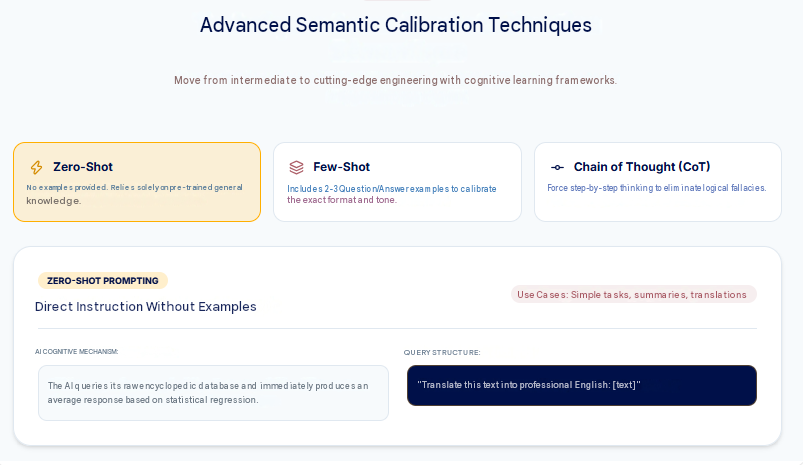
“Zero-shot” vs “Few-shot prompting”
One of the key concepts in prompt engineering is the management of the examples provided to the machine.
- Zero-shot prompting : This is the method we use intuitively. We give the AI a directive without providing it with any prior examples. This technique works very well for simple tasks (translating a text, summarising an article), as modern LLMs have an encyclopaedic knowledge base sufficient to deduce the expected result.
- Few-shot prompting (learning by example) : As soon as your task requires unusual formatting, specific business logic or a very particular writing style, zero-shot prompting reaches its limits. Few-shot prompting involves including 2 to 3 concrete examples of the ‘Question / Expected Answer’ pair directly in your prompt. By showing the algorithm the cognitive path, you ‘calibrate’ its neural weights to your exact logic. This is the go-to technique for automating data classification or forcing the AI to adopt a corporate tone of voice unique to your agency.
The “Chain of Thought” technique (Step-by-step reasoning)
This is undoubtedly one of the most fascinating discoveries in the study of generative artificial intelligence behaviour. When a complex logical or strategic problem is presented to an LLM and an immediate response is required, it tends to “hallucinate” or produce flawed reasoning.
The “Chain of Thought” technique elegantly solves this problem. It involves forcing the AI to break down its own thought process before delivering its conclusion.
- The engineering trick : It is often enough to add a magic phrase at the end of your prompt : “Let’s think through this step by step”, or “Break down your reasoning point by point before giving me the final answer”.
- Why it works : By generating its reasoning sequentially, the AI generates its own context tokens. It relies on the logical sentence it has just constructed to calculate the next one. This drastically reduces logical errors. It is an effective way of refining the relevance of the marketing strategies proposed by the AI and ensures much more robust algorithmic decision-making.
By forcing the tool to verbalise its thought process, you transform a simple text-generation tool into a genuine partner in strategic thinking.
4. Case Studies : Using Prompting to Boost Your Productivity
Theory is essential, but it is in practice that prompt engineering reveals its true value. For an SME, an agency or a self-employed entrepreneur, the aim is not to converse with the machine, but to drastically speed up business processes.
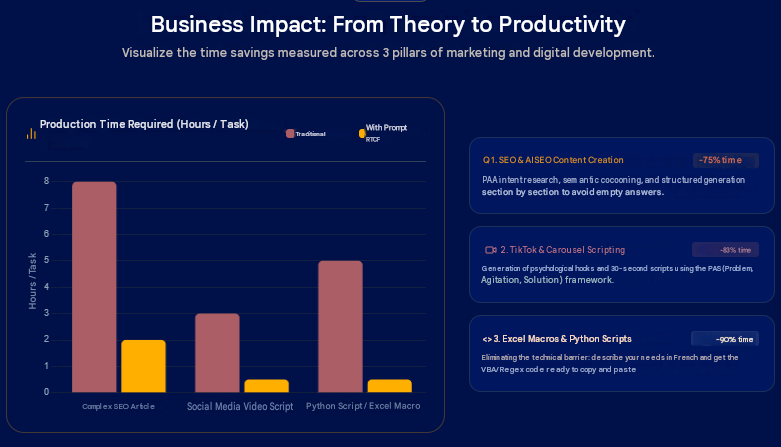
Let’s look at how to turn your queries into real drivers of operational growth through three pillars of digital marketing.
SEO content creation and web copywriting
Search engine optimisation requires a significant volume of content and impeccable semantic relevance. Historically, producing dozens of articles used to take weeks. Today, AI acts as an editorial assistant capable of handling the research work, provided you know how to use it effectively.
Never ask an LLM to write a complete article in one go. The secret lies in iteration.
- Research phase : First, ask the AI to list search intent and frequently asked questions relating to your main keyword.
- Structuring phase : Use this data to generate a detailed outline (H2, H3). It is at this stage that the algorithm becomes a formidable tool for brainstorming and structuring your ideas to build powerful semantic clusters.
- Writing phase : Once the outline has been approved, generate the content section by section, providing your own source data (interviews, internal figures).
Thanks to this step-by-step method, you’ll be able to produce content at scale without compromising on quality, whilst retaining the unique expertise that sets your brand apart on search engines.
Social media strategy (Instagram, TikTok)
On social media platforms, attention spans are measured in milliseconds. Producing ‘average’ content is a waste of time: you need to capture attention, hold it, and then convert. AI excels at generating ideas for psychological ‘hooks’.
For your short videos, instead of staring at a blank page for inspiration, provide the AI with a proven copywriting framework.
- Example video prompt : “Act as a copywriter specialising in TikTok. Write five 30-second video scripts to promote our B2B invoicing software. Use the PAS framework (Problem, Agitation, Solution). Each script must begin with a provocative question that grabs attention from the very first second.”
Social media algorithms evolve rapidly. If you master the art of formulating these prompts, you’ll speed up your production. However, human creativity remains the ultimate arbiter. For businesses aiming for aggressive virality without spreading their internal resources too thin, the most strategic choice is often to delegate the scripting and management of your short videos to experts who are proficient in both the prompts and the platform’s cultural codes.
Data processing and scripts
This is one of the uses most underestimated by non-developers. Do you spend hours cleaning up customer databases in Excel or formatting email lists for your campaigns? Artificial intelligence can write complex formulas or automation scripts for you.
- The productivity hack : Explain your problem in plain English. “I have a column A with first and last names mixed up and a column B with incorrectly formatted phone numbers. Write me the exact VBA macro or Excel formula to clean it all up according to the international standard.”
- The result : The tool provides you with code ready to copy and paste. Prompt engineering breaks down the technical barrier. You no longer need to learn to code to carry out complex technical tasks.
5. Common mistakes to avoid (and how to correct them)
The excitement surrounding generative AI is prompting many professionals to use it without a safety net. However, entrusting business decisions to a probabilistic algorithm carries significant risks. Here are the pitfalls to avoid to ensure your production remains secure.
AI hallucinations
This is the Achilles’ heel of large language models. When an AI does not know the answer, its architecture often prompts it to invent one rather than admit its ignorance. It then generates fabricated facts, figures or quotations with terrifying confidence. This phenomenon is known as a “hallucination”.
- How to avoid it : Always include safeguards in your prompts. Add the instruction: “If you cannot find the exact information in the text provided, reply ‘Information unavailable’. Do not invent any data.”
- Double-checking : Never publish text generated entirely by a machine without fact-checking. To ensure accuracy and maintain your brand’s tone, opt for a hybrid writing approach that combines human creativity with the power of the algorithm. The prompt generates the rough draft; the human mind refines and validates it.
Ignoring ethical boundaries and confidentiality
This is a mistake made by many SMEs, particularly during periods of rapid digitalisation. Free or consumer versions of tools such as ChatGPT often use your conversations to train their future models.
- The golden rule : Never copy and paste sensitive data into an unsecured prompt.
- Data to avoid : Passwords, non-public financial statements, proprietary source code or databases containing personal information (GDPR). If you need to analyse internal data, ensure you anonymise it first or use private, isolated AI instances designed for businesses.
6. Integrating prompting into your digital ecosystem
Mastering the search bar on a web interface is just the tip of the iceberg. The real digital revolution takes place when prompt engineering breaks out of its bubble to connect with the rest of your business tools.
APIs and no-code automation
Imagine if every email received from a prospect were automatically analysed by AI, summarised, categorised according to its level of urgency, and then entered into your CRM (Customer Relationship Management) system without any human intervention. This isn’t science fiction; it’s the norm today.
Thanks to no-code tools (such as Make or Zapier), your carefully designed queries can be transformed into seamless workflows. By embedding your best prompts into these workflows, you’ll be able to deploy automated processes to link your everyday tools. AI then becomes the analytical brain that drives all your digital operations in the background.
The future of prompt engineering
The profession is set to evolve. In the future, we will no longer be limited to making isolated text-based queries. ‘Autonomous Agents’ already exist: artificial intelligence systems with an overarching objective, capable of breaking down their own tasks, navigating the web and carrying out complex actions from start to finish.
In the fields of e-commerce and customer service, prompt engineering is already the core skill required to design conversational assistants capable of generating sales. These next-generation bots no longer simply answer FAQs; they qualify leads, negotiate and guide the user through to the final transaction.
Conclusion
Prompt engineering is not merely a technological trend; it is the new foundation of digital literacy. What is currently seen as a ‘bonus’ skill or a ‘soft skill’ is fast becoming an essential operational prerequisite for anyone working in the professional sphere, whether in Africa, Europe or elsewhere.
The secret to excelling ? Practice, iteration and contextual precision. Don’t just talk to AI; direct it. Structure your commands, apply the RTCF framework and demand excellence.
Ready to take it to the next level ? Don’t let your competitors gain a technological edge. The best way to get the most out of these tools is to train your staff in best practices for artificial intelligence. Contact our agency today so we can work together to design the digital strategy that will drive your growth.
FAQ : Frequently asked questions about prompt engineering
Do you need to pay for premium tools to do good prompt engineering ?
No. The free versions of ChatGPT or Claude are more than enough to get started and excel with the RTCF framework. Paid licences, however, offer faster performance, advanced features and guarantee the confidentiality of your business data.
Will prompt engineering replace writers and copywriters ?
Absolutely not. Artificial intelligence produces volume, but lacks real-world experience and empathy. Prompt engineering is a formidable tool that boosts an expert’s productivity tenfold, allowing them to focus on pure analysis and strategy.
What is the number one skill needed to create successful prompts ?
Clarity of thought. A good AI user is not a software developer, but a formidable communicator. You need to know how to structure logical thinking, define a precise context and choose accurate vocabulary to guide the algorithm without ambiguity.
Is my information protected when I interact with the AI ?
By default, no. On consumer-facing interfaces, your data may be used to train future models. Never include confidential strategies, customer data or financial statements. For B2B use, always insist on isolated environments.
Can these techniques be used to generate images ?
Yes. Although the models differ (Midjourney, DALL-E), the rigour required for the prompt remains the same. An effective visual prompt also requires a detailed context: a specific artistic style, lighting type and framing are essential to avoid amateurish results.
Can AI directly optimise my website’s SEO ?
AI generates tags, suggests keywords and structures your content. However, it cannot technically audit your server or create genuine backlinks. Human expertise remains essential for the overall implementation.
What is the maximum number of words a prompt should contain ?
There is no strict limit, but clarity is key. A good prompt is often between 50 and 150 words. Any longer than that, and the algorithm may lose focus and ignore some of your initial instructions.
What should I do if the AI gives me a poor result ?
Don’t start from scratch. Use the iteration technique. Simply tell the AI what’s wrong: “The tone is too formal, make it warmer” or “You’ve left out this statistic”. Adjust your approach gradually.
Should I say “hello” and “please” to the AI ?
Technically, this is completely pointless for the algorithm, which ignores politeness. However, phrasing your requests in a courteous and structured manner forces your brain to adopt a collaborative mindset, which often results in much clearer instructions.
Is there a library of ready-to-use, universal prompts ?
You’ll find thousands of free templates online. However, a copy-and-paste prompt will always produce generic results. The challenge is to adapt these templates by incorporating your specific context, your own data and your business objectives.