Let’s face it—budget is one of the primary concerns for most companies that want to advertise online. What they often miss is that return on ad spend (ROAS) can be improved by increasing ad spend efficiency and revenue generation. As a Shopify merchant, you already have plenty of advantages to enjoy through Shopify’s marketing tools and advertising integrations. It’s just that you should understand your audience’s behavior well, select the right creatives for them, and build campaigns that align with the product discovery and evaluation process. When you go deeper into the platform-specific dynamics, your chances of outperforming the competition become even better.
However, this may sound like too much when you already have a business to run. The good thing is you can pass this responsibility on to a reputable Shopify Ads agency. They have the resources and expertise to handle every aspect of your advertising campaigns from start to finish. Plus, bidding and targeting have become much easier because of automation and machine learning. Here is a quick look at a few areas that they especially focus on to improve your Shopify ROAS.
Account setup and tracking
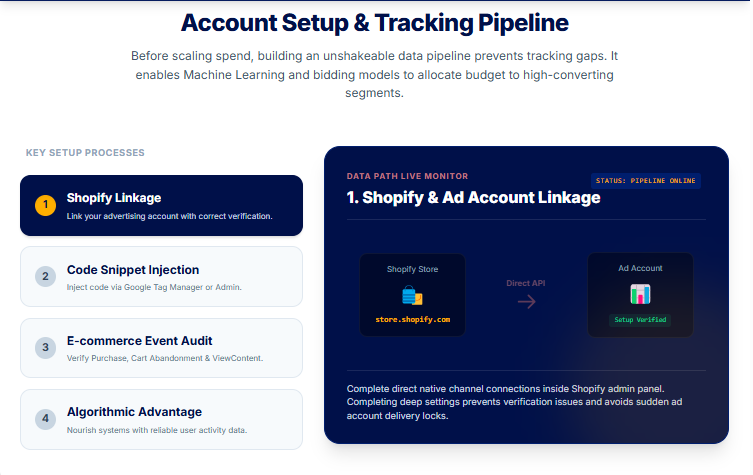
An agency will create your advertising account and link it with your Shopify store using the right integration method. From domain verification to payment setup, every aspect will be taken care of. Configuring the account correctly is the most important step to avoid account limitations and tracking issues that may hinder your campaigns. After this, they will add a small piece of tracking code to your Shopify store to collect data on visitors’ behavior on your site. You can trust them to decide how this should be implemented—through Google Tag Manager or the Shopify admin. It doesn’t end there.
All the main e-commerce events should also be verified properly to ensure accurate data collection. They know which validation tool to use for this purpose. Good tracking data helps the algorithm optimize your campaigns more effectively. However, there is still a lot more to be done.
Campaign structure and strategy
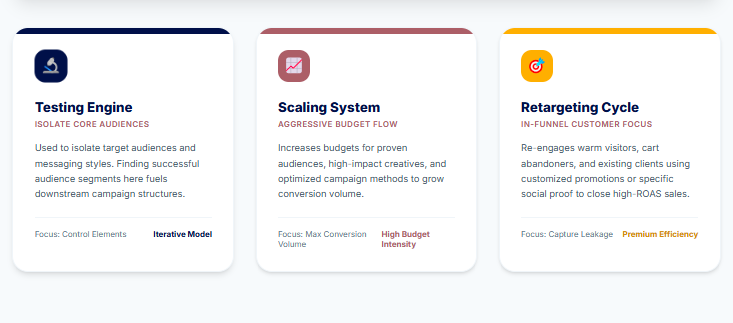
Professionals know that it’s essential to create three sets of advertising campaigns: testing, scaling, and retargeting.
- Testing campaigns are used to test new audiences, creatives, and messaging.
- Scaling campaigns focus on increasing budgets for proven audiences, creatives, and campaign strategies.
- Retargeting campaigns are designed to reconnect with returning visitors, cart abandoners, and existing customers.
Note: A smart agency professional knows how much budget to allocate to each campaign. Although the allocation may vary depending on business goals and campaign performance, testing and scaling campaigns generally receive 60% of the advertising budget. 25% is usually allocated to retargeting and 15% to creative testing.
Audience targeting
Shopify’s advertising integrations offer various targeting options to help you reach different target groups at each stage of the buyer journey. Average order value (AOV), blended return on ad spend (ROAS), and ROAS calculations are some of the performance metrics used to evaluate and optimize a campaign structure. For example, some advertisers use behavioral targeting to expand their reach to new audiences that fit their customer profile. Audience size should be predetermined to improve delivery, speed up the learning phase, and maintain efficient campaign performance.
This shows that there is significant scope to improve your ROAS for your Shopify store. That’s why you need the right agency to manage your campaigns.